
Shopify Sales Data Export No Code
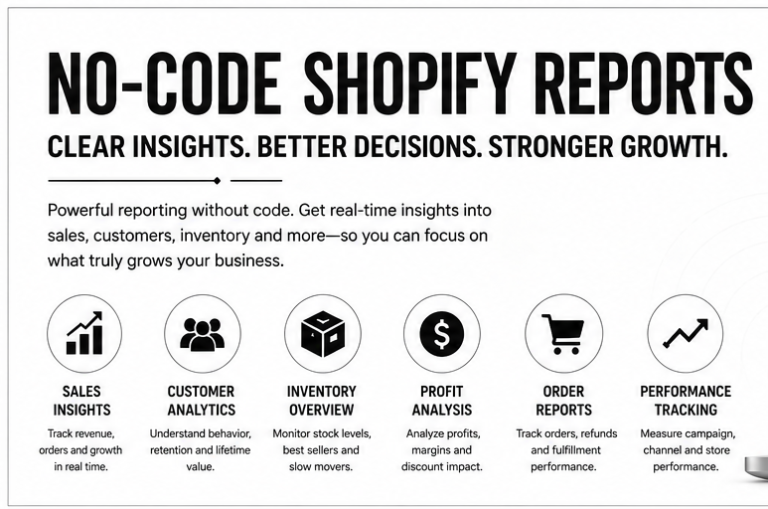
In the modern eCommerce industry, data has become one of the most valuable assets for every online business. Every product sold, every customer interaction, every refund, and every transaction creates information that can help Shopify businesses improve operations, understand customer behavior, and make smarter business decisions.
However, collecting data is only the beginning.
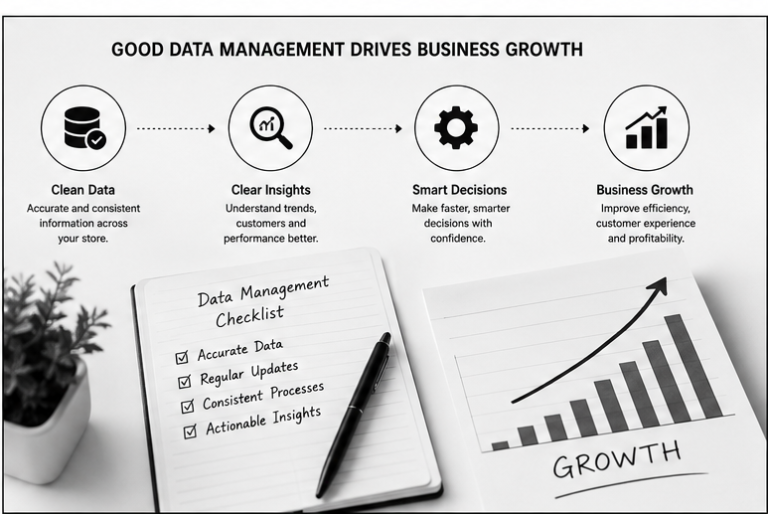
The real value comes from organizing, accessing, and analyzing that data in a way that supports business growth.
This is why Shopify sales data export without coding has become increasingly important for modern businesses.
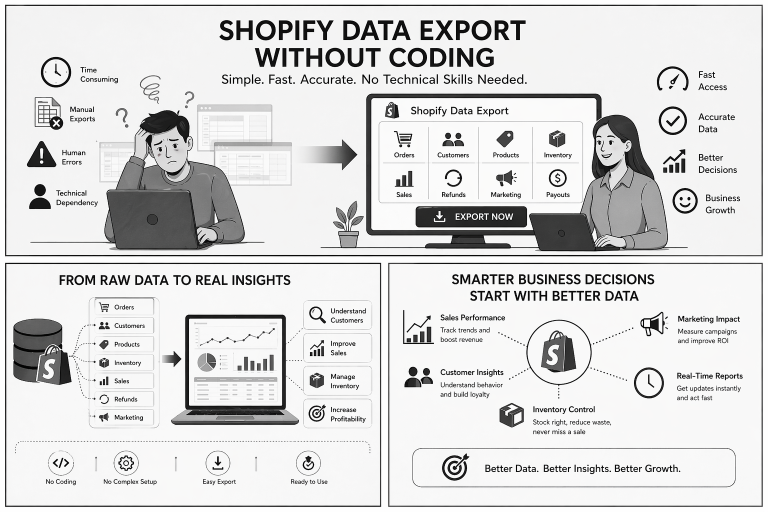
Today’s Shopify store owners want faster access to sales information without depending on technical expertise, complicated systems, or developer support. Businesses need simple and efficient ways to export sales data so they can analyze performance, track growth, improve reporting, and make better decisions.
The future of eCommerce operations is moving toward simplicity, accessibility, and smarter workflows.
And no-code Shopify sales data export is becoming a major part of that transformation.
Understanding Shopify Sales Data
Every Shopify store generates large amounts of sales-related information every single day.
This may include:
- Orders
- Revenue
- Product sales
- Customer purchases
- Refund activity
- Shipping information
- Payment details
- Tax records
- Discounts and promotions
For growing businesses, this information becomes essential for understanding overall store performance.
Sales data helps businesses answer important questions such as:
- Which products perform best?
- Which customers generate the highest revenue?
- Which regions produce the strongest sales?
- Which time periods generate the most conversions?
- Which marketing campaigns drive profitable purchases?
Without organized access to this information, businesses struggle to make informed decisions.
Why Businesses Need Sales Data Export
As Shopify stores grow, business operations become more data-driven.
Store owners, marketing teams, finance departments, and operations managers all depend on accurate sales reporting.
Exporting Shopify sales data allows businesses to:
- Analyze revenue trends
- Create business reports
- Track financial performance
- Improve inventory planning
- Monitor customer behavior
- Support accounting processes
- Optimize operational strategies
Instead of viewing limited information inside the store dashboard, exported data provides greater flexibility for analysis and business planning.
This improves operational visibility across the organization.
The Growing Demand for No-Code Operations
One of the biggest changes happening in modern eCommerce is the rise of no-code business operations.
Historically, advanced reporting and data management often required technical knowledge or developer involvement.
This created several challenges:
- Slow reporting processes
- Dependency on technical teams
- Delayed decision-making
- Complicated workflows
- Limited accessibility for non-technical users
But most Shopify businesses are not operated by developers.
They are managed by entrepreneurs, marketers, small business owners, and operational teams who need quick access to information without technical complexity.
This is why no-code workflows are becoming increasingly valuable.
Businesses want operational simplicity without sacrificing business intelligence.
Simplifying Sales Reporting
Traditional sales reporting can become overwhelming when businesses rely heavily on spreadsheets, manual exports, or disconnected reporting systems.
As order volume increases, data management becomes more difficult.
Businesses often struggle with:
- Organizing reports
- Managing large datasets
- Updating spreadsheets manually
- Comparing multiple reports
- Tracking performance consistently
No-code sales data export simplifies this process by making information easier to access and organize.
This allows businesses to focus less on technical reporting and more on strategic decision-making.
Faster Access to Business Insights
Speed is becoming one of the most important competitive advantages in eCommerce.
Businesses need immediate visibility into store performance.
Delays in accessing sales data can slow down:
- Marketing optimization
- Inventory decisions
- Revenue forecasting
- Customer analysis
- Operational planning
No-code export systems improve business agility by making data more accessible.
Teams can analyze performance faster and respond more quickly to changing business conditions.
This creates stronger operational flexibility.

Improving Financial Visibility
Sales data is closely connected to financial management.
Businesses need accurate reporting for:
- Revenue tracking
- Profit analysis
- Tax reporting
- Expense management
- Financial forecasting
Without organized sales exports, financial planning becomes more difficult.
No-code workflows simplify access to financial information and improve reporting accuracy.
This helps businesses maintain better visibility into overall business health.
Clear financial visibility supports smarter growth strategies and stronger long-term planning.
Better Inventory Management Through Sales Data
Inventory management is one of the most critical operational areas for Shopify businesses.
Sales data provides important insights into:
- Fast-selling products
- Slow-moving inventory
- Seasonal demand trends
- Product performance patterns
- Stock planning needs
Without proper sales visibility, businesses may experience:
- Overstocking
- Stock shortages
- Cash flow pressure
- Lost sales opportunities
Exported sales data allows businesses to analyze purchasing trends more effectively and improve inventory planning.
This creates healthier operational efficiency.
Understanding Customer Purchasing Behavior
Customer behavior analysis is becoming increasingly important in Shopify eCommerce.
Sales data helps businesses understand:
- Repeat purchase behavior
- Average order value
- Customer lifetime value
- Product preferences
- Buying frequency
These insights allow businesses to improve:
- Customer retention
- Marketing personalization
- Product recommendations
- Loyalty strategies
The more clearly businesses understand customer behavior, the more effectively they can improve long-term growth.
Improving Marketing Decisions
Marketing performance is closely connected to sales data.
Businesses need visibility into:
- Revenue by campaign
- Customer acquisition performance
- Product conversion trends
- Promotional effectiveness
- Sales channel performance
Without proper data organization, marketing decisions often rely too heavily on assumptions.
Exported sales reporting helps businesses understand which strategies generate actual business results.
This improves marketing efficiency and reduces wasted spending.
Data-driven marketing creates more profitable growth.
Reducing Manual Work
Manual reporting creates operational inefficiency.
Many businesses still spend hours:
- Organizing spreadsheets
- Updating reports manually
- Comparing disconnected data
- Preparing operational summaries
This repetitive work consumes valuable time that could be used for strategy and business growth.
No-code workflows reduce this burden by simplifying data organization and improving reporting accessibility.
Operational efficiency improves significantly when repetitive administrative tasks are reduced.
Making Data Accessible to Non-Technical Teams
One of the biggest advantages of no-code sales data export is accessibility.
Modern businesses involve multiple departments that depend on sales information.
These may include:
- Marketing teams
- Operations managers
- Finance departments
- Customer support teams
- Leadership teams
Not every department has technical expertise.
No-code systems ensure that important business information becomes easier for everyone to access and understand.
This improves collaboration across the organization.
Better Visibility Leads to Better Decisions
Strong business decisions depend on clear visibility.
Without organized reporting, businesses often struggle to identify:
- Growth opportunities
- Operational inefficiencies
- Customer trends
- Revenue patterns
- Profitability issues
Sales data exports improve visibility by allowing businesses to analyze performance more clearly.
This creates more confident decision-making.
Businesses can act faster because they understand their operations more accurately.
Supporting Business Scalability
As Shopify businesses grow, operational complexity increases rapidly.
More products, customers, transactions, and marketing channels create larger amounts of information.
Manual reporting systems often become difficult to manage at scale.
No-code data workflows help businesses maintain organized reporting even as operations expand.
This improves scalability by ensuring that growth does not create operational confusion.
Businesses can scale more smoothly and maintain stronger operational control.
The Shift Toward Smarter ECommerce Operations
Modern eCommerce businesses are becoming more operationally intelligent.
Instead of relying only on manual management, businesses are building systems that improve visibility, simplify workflows, and support faster decision-making.
Sales data export is part of this broader transformation.
Businesses are learning that organized information creates competitive advantages.
The ability to access, analyze, and understand data quickly is becoming essential for long-term growth.
Simplicity Is Becoming More Valuable
One major trend shaping the future of Shopify operations is simplicity.
Businesses no longer want complicated reporting systems that require constant technical support.
They want systems that are:
- Easy to use
- Easy to understand
- Easy to scale
- Focused on actionable insights
Simplicity improves productivity across the organization.
When teams can access data easily, decision-making becomes faster and more effective.
Real-Time Business Awareness
Modern Shopify businesses operate in fast-changing markets.
Customer behavior, product demand, and marketing performance can shift quickly.
Businesses need timely access to sales data to remain competitive.
No-code reporting workflows support faster operational awareness by improving accessibility and reducing reporting delays.
This allows businesses to react more quickly to:
- Market changes
- Product demand shifts
- Sales opportunities
- Operational challenges
Agility becomes a major business advantage.
The Future of Shopify Sales Operations
The future of Shopify sales operations will continue moving toward:
- Greater automation
- Better visibility
- Faster reporting
- Simplified workflows
- Smarter operational systems
Businesses will increasingly prioritize systems that reduce manual effort while improving operational intelligence.
No-code operations support this future by making advanced workflows accessible to businesses of all sizes.
This creates a more efficient and competitive eCommerce environment.
Final Thoughts
Shopify sales data export without coding is transforming how modern eCommerce businesses manage operations, analyze performance, and make decisions.
By simplifying access to important business information, businesses can improve:
- Sales visibility
- Financial reporting
- Customer understanding
- Inventory planning
- Marketing performance
- Operational efficiency
Most importantly, no-code workflows allow businesses to focus less on technical complexity and more on strategic growth.
In today’s competitive eCommerce industry, success is no longer determined only by how much data businesses collect.
It is determined by how effectively they can access, understand, and use that data to drive smarter business decisions.
Because the future of Shopify growth belongs to businesses that can turn operational simplicity into long-term competitive advantage.