The Business Cost of Poor Shopify Data Management
Modern Shopify businesses depend heavily on data.
Every order, customer interaction, inventory update, product view, refund, marketing campaign, and shipping event creates information that helps businesses understand how their store is performing.
In today’s eCommerce environment, data is no longer just operational support.
It has become one of the most valuable business assets.
But while many Shopify businesses collect enormous amounts of information, far fewer manage it effectively.
This creates a major hidden problem across modern eCommerce operations:
Poor Shopify data management.
At first, weak data organization may seem like a minor operational issue.
A few messy spreadsheets.
Disconnected reports.
Incomplete product information.
Inconsistent customer records.
But over time, these problems grow into serious business challenges that affect profitability, customer experience, operational efficiency, and long-term growth.
The true cost of poor data management is often invisible in the beginning.
But eventually, businesses start paying for it through slower operations, missed opportunities, customer frustration, and poor decision-making.
Data Is the Foundation of Modern Shopify Operations
Every Shopify business relies on data to operate effectively.
Businesses use information to manage:
- Products
- Inventory
- Customers
- Sales
- Marketing
- Fulfillment
- Financial reporting
- Customer support
- Growth strategy
Without organized visibility into these areas, businesses struggle to maintain operational control.
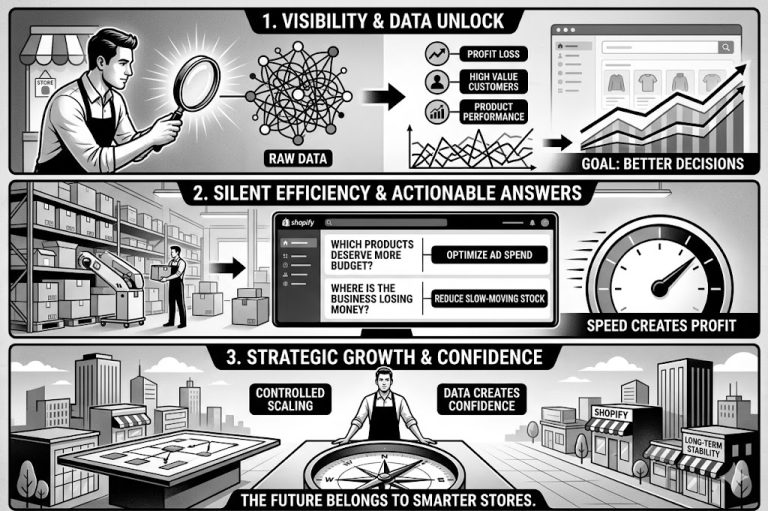
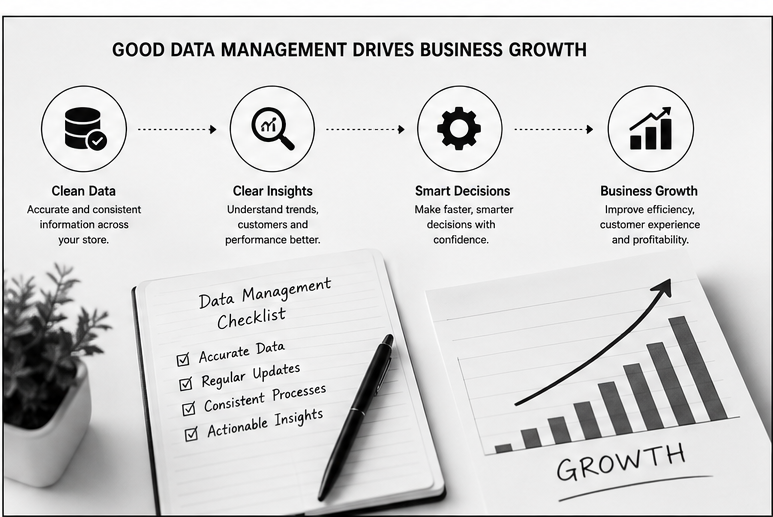
Good data management creates clarity.
Poor data management creates confusion.
And confusion inside business operations eventually becomes expensive.
Poor Visibility Leads to Poor Decisions
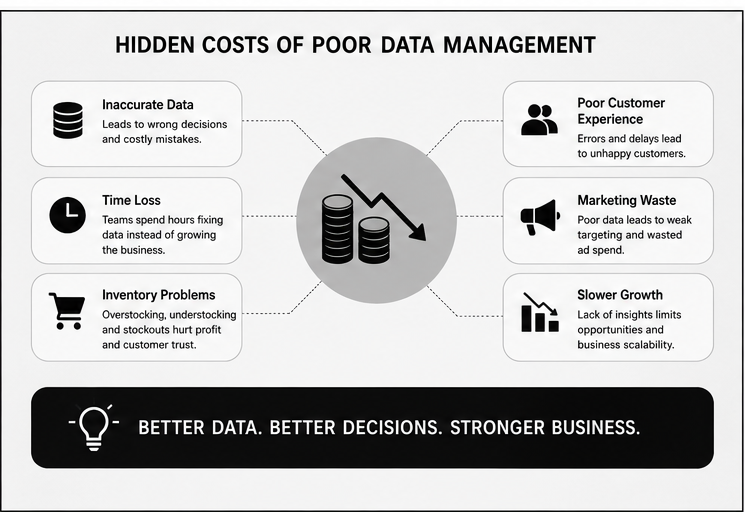
One of the biggest costs of weak Shopify data management is poor decision-making.
Businesses make hundreds of decisions every month involving:
- Pricing
- Marketing budgets
- Inventory purchasing
- Product launches
- Customer retention
- Promotions
- Operational improvements
When data is disorganized, incomplete, or inconsistent, decision-making becomes unreliable.
Businesses begin operating based on assumptions instead of accurate insights.
For example:
- A product may appear profitable while hidden costs reduce margins
- Marketing campaigns may seem successful while customer retention declines
- Inventory reports may fail to reflect actual stock movement
- Customer behavior trends may go unnoticed
Without clear visibility, businesses risk making expensive strategic mistakes.
Operational Efficiency Declines
Poor data management creates operational friction across the entire business.
Teams often waste hours:
- Searching for information
- Updating spreadsheets manually
- Fixing reporting inconsistencies
- Comparing disconnected systems
- Correcting product records
- Verifying inventory numbers
These repetitive tasks reduce productivity.
Instead of focusing on growth, customer experience, and strategy, teams become trapped inside administrative maintenance work.
As businesses scale, operational inefficiency becomes even more damaging.
Small workflow issues multiply rapidly across larger operations.
Human Error Increases Significantly
Manual and poorly organized workflows increase the likelihood of mistakes.
Businesses commonly experience:
- Duplicate records
- Missing product information
- Incorrect inventory updates
- Inconsistent pricing data
- Reporting inaccuracies
- Customer record confusion
Even small errors can create serious business consequences.
For example:
- Incorrect inventory data may lead to overselling
- Pricing mistakes may reduce profitability
- Missing product details may hurt customer trust
- Inaccurate reports may influence poor strategic decisions
Human error becomes more common when systems lack organization and consistency.
Customer Experience Suffers Quietly
Many Shopify businesses underestimate how strongly data management affects customer experience.
Customers expect:
- Accurate product information
- Consistent inventory availability
- Personalized experiences
- Smooth order fulfillment
- Reliable communication
Poor data organization weakens these experiences.
For example:
- Customers may receive incorrect product information
- Inventory errors may create order delays
- Incomplete customer records may reduce personalization
- Shipping confusion may damage customer trust
These issues may appear operational internally, but customers experience them directly.
Poor customer experiences often lead to:
- Negative reviews
- Refund requests
- Reduced loyalty
- Lower repeat purchases
- Brand reputation damage
Customer trust becomes harder to maintain when operational visibility is weak.
Inventory Problems Become More Expensive
Inventory management is one of the most sensitive areas affected by poor data management.
Weak inventory visibility creates major operational risks:
- Overstocking
- Understocking
- Delayed restocking
- Inventory mismatches
- Slow-moving product accumulation
These problems directly impact cash flow and profitability.
For example:
Too much inventory locks working capital into unsold products.
Too little inventory creates missed sales opportunities and frustrated customers.
Without organized inventory data, businesses struggle to balance stock levels efficiently.
Inventory problems often grow quietly until they create serious financial pressure.
Marketing Performance Weakens
Modern marketing depends heavily on accurate data.
Businesses need reliable visibility into:
- Customer behavior
- Campaign performance
- Conversion trends
- Audience segmentation
- Purchase patterns
Poor data management weakens marketing effectiveness.
Businesses may struggle to identify:
- Which campaigns drive profitable customers
- Which products respond best to promotions
- Which customer segments create long-term value
- Which marketing channels waste budget
Without organized insights, marketing decisions become less strategic and more reactive.
This reduces return on investment and increases customer acquisition costs.
Reporting Delays Slow Business Growth
Fast decision-making is essential in modern eCommerce.
But poor data management often creates delayed visibility.
Businesses spend excessive time:
- Exporting reports
- Organizing spreadsheets
- Verifying numbers
- Combining information manually
By the time reports are finally ready, the information may already be outdated.
This slows operational responsiveness.
Businesses react later to:
- Sales declines
- Inventory shortages
- Customer behavior changes
- Marketing inefficiencies
- Product performance issues
In fast-moving Shopify environments, delayed insights create competitive disadvantages.
Scaling Becomes Increasingly Difficult
Small Shopify stores may survive with disorganized workflows temporarily.
But scaling changes everything.
As businesses grow, they manage:
- More products
- More customers
- More orders
- More sales channels
- More operational complexity
Weak data management becomes far more damaging at scale.
Problems that once felt manageable begin affecting multiple departments simultaneously.
Businesses experience:
- Operational bottlenecks
- Slower team coordination
- Increased maintenance workload
- Reduced visibility
- Growing reporting complexity
Scaling without organized data systems creates operational instability.
Teams Lose Alignment
Modern Shopify businesses often involve multiple teams working together.
This may include:
- Marketing
- Operations
- Customer support
- Fulfillment
- Leadership
- Product management
Poor data organization creates communication problems across departments.
Different teams may rely on inconsistent or outdated information.
This creates:
- Confusion
- Duplicate work
- Delayed execution
- Internal frustration
- Misaligned priorities
Strong data management improves collaboration because everyone operates using consistent visibility.
Financial Visibility Weakens
One of the most dangerous consequences of poor data management is reduced financial clarity.
Businesses may struggle to accurately track:
- Profit margins
- Operational costs
- Inventory value
- Customer acquisition costs
- Refund impact
- Product profitability
Revenue alone does not determine business health.
Without accurate operational visibility, businesses may believe performance is strong while profitability quietly declines.
Weak financial visibility increases long-term business risk.
Customer Retention Declines
Customer retention depends heavily on understanding customer behavior.
Businesses need visibility into:
- Repeat purchase patterns
- Customer preferences
- Shopping frequency
- Loyalty trends
- Customer lifetime value
Poor data management weakens this understanding.
Businesses struggle to identify:
- High-value customers
- Retention opportunities
- Churn risk
- Personalized engagement strategies
As a result, customer relationships become weaker and less predictable.
Retention problems often appear slowly but create major long-term revenue loss.
Businesses Become Reactive Instead of Strategic
Poor operational visibility forces businesses into reactive management.
Instead of planning ahead, teams spend most of their time fixing problems after they appear.
Businesses constantly react to:
- Inventory issues
- Reporting inconsistencies
- Customer complaints
- Operational delays
- Marketing inefficiencies
Reactive operations create stress, instability, and reduced growth capacity.
Strategic businesses focus on prevention and optimization.
But prevention becomes difficult without organized data visibility.
Data Complexity Continues Growing
The complexity of Shopify operations continues increasing every year.
Modern businesses now manage:
- Omnichannel selling
- International customers
- Personalized shopping experiences
- Advanced customer segmentation
- Detailed product catalogs
- Real-time operational workflows
This complexity generates larger volumes of operational data.
Businesses that fail to organize information effectively will struggle increasingly over time.
The operational gap between organized and disorganized businesses continues growing.
Simplification Is Becoming Essential
Many businesses assume complex operations require complex systems.
But successful Shopify businesses increasingly prioritize operational simplicity.
Simplified data workflows help businesses:
- Reduce errors
- Improve visibility
- Increase speed
- Strengthen collaboration
- Improve decision-making
Simplicity creates operational agility.
Agile businesses adapt faster to changing customer behavior and market conditions.
Better Data Management Improves Leadership Confidence
Clear visibility improves leadership quality.
When business leaders trust their operational data, they make stronger decisions with greater confidence.
They can:
- Invest strategically
- Identify risks earlier
- Improve operational planning
- Scale more effectively
- Respond faster to opportunities
Confidence comes from clarity.
And clarity depends heavily on organized, reliable data systems.
The Future of Shopify Operations Depends on Better Visibility
The future of Shopify growth will increasingly depend on operational intelligence.
Businesses need systems that provide:
- Faster insights
- Cleaner reporting
- Better organization
- Smarter workflows
- Simplified operations
The goal is not collecting endless information.
The goal is transforming information into actionable business understanding.
Businesses that manage data effectively will operate faster, smarter, and more efficiently.
Final Thoughts
Poor Shopify data management creates far more than operational inconvenience.
It affects:
- Profitability
- Customer experience
- Team productivity
- Marketing performance
- Inventory control
- Decision-making
- Business scalability
The financial and operational cost of disorganized information grows larger as businesses expand.
Modern Shopify businesses can no longer rely on fragmented spreadsheets, disconnected workflows, and inconsistent reporting systems.
Strong operational visibility has become essential for sustainable growth.
Because in today’s competitive eCommerce environment, the businesses that grow strongest are not simply the ones collecting the most data.
They are the businesses that can organize information clearly, reduce operational complexity, and transform accurate insights into faster, smarter business decisions.