
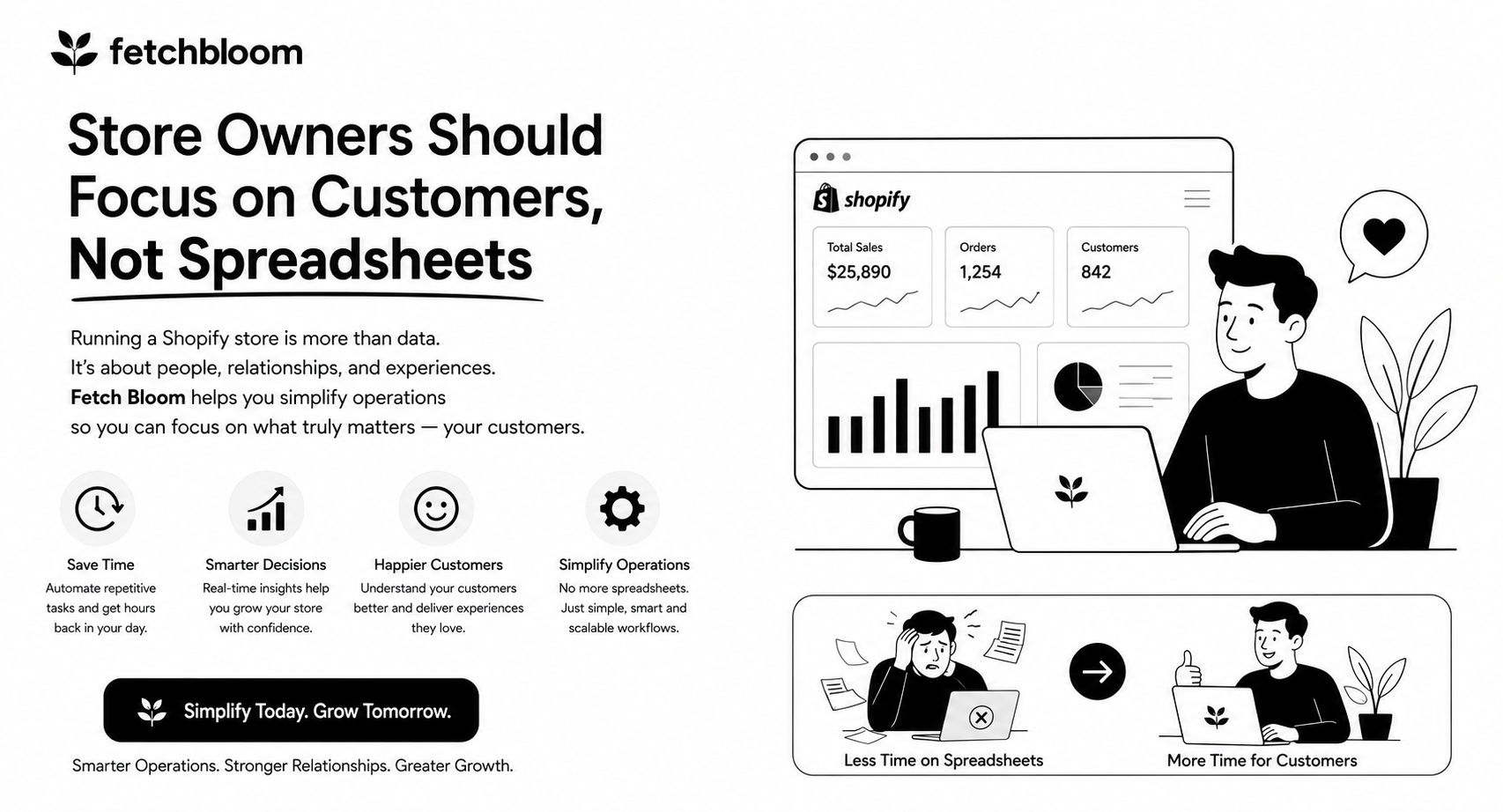
Store Owners Should Focus on Customers, Not Spreadsheets
The world of eCommerce has changed dramatically over the past few years. Running a Shopify store is no longer just about uploading products and waiting for sales. Modern online businesses manage customer expectations, marketing campaigns, inventory systems, order fulfillment, analytics, promotions, shipping coordination, and customer engagement — often all at the same time.
As stores grow, operations become more complicated.
Many Shopify store owners eventually find themselves spending less time building customer relationships and more time handling spreadsheets, reports, manual tracking, and repetitive operational work.
This creates a major problem.
Businesses begin focusing more on managing data than understanding customers.
And in today’s competitive eCommerce environment, customer experience is what truly drives long-term growth.
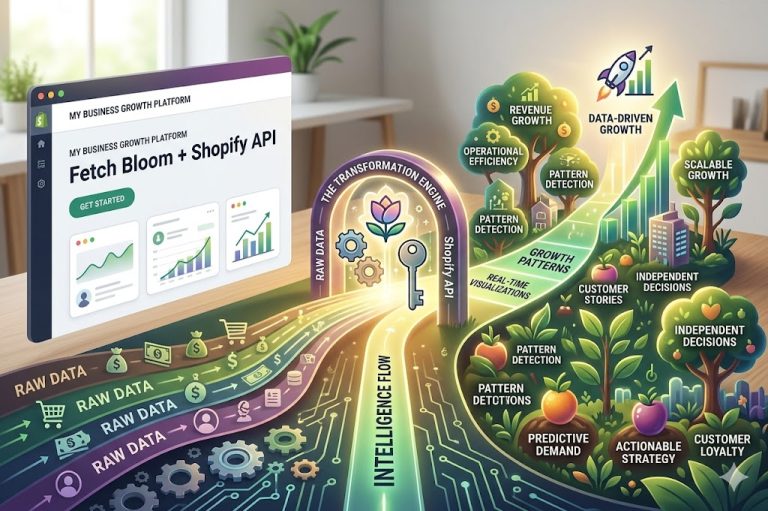
This is why platforms like Fetch Bloom are becoming increasingly important for modern Shopify businesses. Instead of overwhelming store owners with operational complexity, businesses are now shifting toward smarter workflows that simplify data management and improve decision-making.
The future of Shopify growth is not about spending hours inside spreadsheets.
It is about spending more time understanding customers, improving experiences, and building stronger business relationships.
The Hidden Problem With Spreadsheet-Driven Operations
Spreadsheets have been a common part of business operations for years.
Many Shopify businesses use spreadsheets to manage:
- Sales reports
- Inventory tracking
- Customer information
- Marketing performance
- Financial records
- Order management
- Product analysis
At first, spreadsheets may seem manageable.
But as stores grow, spreadsheets often become operational bottlenecks instead of productivity tools.
Businesses begin spending excessive time:
- Updating data manually
- Organizing reports
- Comparing disconnected information
- Managing repetitive tasks
- Fixing data inconsistencies
Instead of improving customer experiences, store owners become trapped in operational administration.
This creates unnecessary pressure and slows down business growth.
Shopify Businesses Generate Massive Amounts of Data
Modern Shopify stores produce enormous amounts of information every day.
Every customer interaction creates data:
- Product views
- Purchases
- Cart activity
- Returns
- Customer support requests
- Marketing responses
- Repeat purchases
- Inventory movement
The problem is not the lack of information.
The problem is managing it effectively.
Many store owners become overwhelmed trying to organize all this data manually.
Instead of helping businesses grow, disconnected reporting systems often create confusion and operational fatigue.
This is where smarter operational systems become essential.
Customers Should Be the Center of Every Shopify Business
At its core, every successful Shopify store grows because of customers.
Customers drive:
- Revenue
- Brand loyalty
- Repeat purchases
- Word-of-mouth marketing
- Long-term business sustainability
Yet many businesses accidentally prioritize operations over customer relationships.
When store owners spend most of their time inside spreadsheets, they lose visibility into what truly matters:
- Customer experience
- Customer satisfaction
- Customer behavior
- Customer retention
- Customer trust
The strongest eCommerce businesses focus deeply on understanding their customers rather than constantly managing administrative tasks.
Because growth comes from relationships, not spreadsheets.
Operational Complexity Reduces Business Agility
One major problem with spreadsheet-heavy workflows is reduced agility.
Modern eCommerce moves extremely fast.
Customer trends change quickly.
Product demand shifts rapidly.
Marketing performance fluctuates constantly.
Businesses that rely heavily on manual reporting often struggle to respond quickly.
For example:
- Sales insights may arrive too late
- Inventory issues may go unnoticed
- Customer behavior changes may be missed
- Marketing decisions may become delayed
This slows down decision-making.
Shopify businesses need faster visibility and simpler workflows to remain competitive.
This is why businesses are increasingly moving toward smarter operational systems that reduce manual effort and improve business clarity.
Fetch Bloom and the Shift Toward Smarter Operations
Fetch Bloom represents a modern approach to Shopify business operations.
Instead of forcing store owners to spend hours organizing spreadsheets manually, the focus shifts toward creating clearer, more actionable business visibility.
The goal is simple:
Help Shopify businesses spend less time managing operations and more time growing customer relationships.
Modern eCommerce businesses need operational systems that:
- Simplify workflows
- Organize data efficiently
- Improve visibility
- Support faster decisions
- Reduce repetitive tasks
When operational systems become simpler, businesses become more customer-focused.
And customer-focused businesses grow faster.
Better Customer Understanding Creates Better Growth
One of the biggest advantages of smarter operational systems is improved customer understanding.
Businesses can more clearly identify:
- Which customers purchase most frequently
- Which products customers prefer
- What drives repeat purchases
- Which experiences improve loyalty
- Where customer frustrations exist
This allows Shopify businesses to make more strategic decisions.
Instead of guessing what customers want, businesses can understand customer behavior more clearly and improve experiences more effectively.
This creates stronger long-term growth.
Time Is One of the Most Valuable Business Resources
Store owners often underestimate how much time manual workflows consume.
Hours spent managing spreadsheets could instead be invested into:
- Customer engagement
- Product development
- Marketing improvements
- Brand building
- Business strategy
- Customer retention
Time lost to repetitive operational work creates opportunity loss.
Businesses grow faster when leadership focuses on high-value activities instead of administrative maintenance.
This is why operational simplicity is becoming a major competitive advantage in modern Shopify eCommerce.
Simplifying Data Improves Decision-Making
Data itself is not the problem.
Complexity is the problem.
Many Shopify businesses already have access to valuable information.
But disconnected spreadsheets make it difficult to understand what truly matters.
Store owners often struggle to identify:
- Important trends
- Growth opportunities
- Customer patterns
- Operational weaknesses
Simplified visibility improves decision-making speed and accuracy.
When businesses can clearly understand their operations, they make smarter decisions faster.
And faster decisions create stronger competitive advantages.
Customer Experience Is Becoming the Real Differentiator
In competitive Shopify markets, products alone are no longer enough.
Many stores sell similar products at similar prices.
The real difference often comes from customer experience.
Customers remember businesses that provide:
- Faster support
- Better communication
- Smoother purchasing experiences
- Personalized engagement
- Reliable service
Businesses that spend less time managing spreadsheets can invest more energy into improving these customer experiences.
This strengthens customer loyalty and improves long-term retention.
Smarter Workflows Reduce Stress
Running a Shopify business can become overwhelming when operations rely heavily on manual management.
Store owners often feel constant pressure to:
- Monitor reports
- Update spreadsheets
- Track performance manually
- Organize disconnected information
This creates operational stress.
Smarter workflows reduce this pressure by simplifying operational management.
Businesses gain:
- Better organization
- Improved visibility
- Faster reporting
- More structured operations
This creates greater operational confidence and stability.
Shopify Growth Requires Operational Scalability
As Shopify stores grow, operational complexity increases rapidly.
More products.
More customers.
More orders.
More marketing channels.
More customer interactions.
Without scalable systems, operational chaos begins to appear.
Spreadsheet-based workflows often struggle to support long-term scalability because manual management becomes increasingly difficult.
Fetch Bloom supports a more scalable operational approach by helping businesses simplify complexity and maintain visibility as operations expand.
This creates healthier and more sustainable business growth.
Marketing Becomes More Effective With Better Visibility
Marketing decisions become stronger when businesses clearly understand customer behavior and sales performance.
Businesses can identify:
- Which campaigns drive conversions
- Which products perform best
- Which audiences respond most effectively
- Which customer segments create long-term value
Without organized visibility, marketing decisions often rely on assumptions.
Simplified operational systems help Shopify businesses make more strategic marketing decisions and improve return on investment.
Data Should Support Business Growth, Not Slow It Down
Many businesses accidentally create operational environments where data management becomes more difficult than the actual business itself.
This creates friction across the organization.
The purpose of business data is not to create complexity.
Its purpose is to improve understanding.
Fetch Bloom supports this philosophy by helping Shopify businesses focus on actionable insights instead of operational overload.
When data becomes easier to understand, businesses operate more intelligently.
The Future of Shopify Is Simplicity
The future of Shopify operations is moving toward simplicity, clarity, and operational intelligence.
Businesses no longer want overly complicated workflows that require constant manual management.
They want systems that:
- Save time
- Improve visibility
- Reduce repetitive work
- Simplify reporting
- Support customer-focused growth
Operational simplicity improves agility and scalability.
And businesses that operate more efficiently can focus more deeply on customers.
Strong Businesses Focus on Relationships
At the center of every successful Shopify business is customer trust.
Customers return to businesses that understand them, communicate clearly, and create positive experiences consistently.
Spreadsheets do not create loyalty.
Customer experiences do.
When operational systems become more organized, businesses gain more freedom to focus on:
- Customer satisfaction
- Community building
- Brand loyalty
- Long-term relationships
This creates stronger business foundations.
Final Thoughts
Modern Shopify businesses are generating more data than ever before.
But success is no longer determined by how many spreadsheets businesses manage.
It is determined by how effectively businesses can simplify operations and focus on customers.
Store owners should spend less time organizing disconnected reports and more time building meaningful customer experiences.
This is why smarter operational systems like Fetch Bloom are becoming increasingly valuable in modern eCommerce.
By simplifying workflows, improving visibility, and reducing operational complexity, Shopify businesses can focus on what truly drives long-term growth:
- Customer relationships
- Customer trust
- Customer satisfaction
- Strategic decision-making
- Sustainable business scalability
Because in the future of eCommerce, the businesses that win will not be the ones buried in spreadsheets.
They will be the businesses that understand customers better than everyone else.