
Shopify Custom Reports: Turning Store Data into Smarter Business Decisions
In today’s eCommerce industry, running a successful Shopify store is no longer only about selling products online. Modern businesses operate in a highly competitive environment where customer behavior changes quickly, marketing costs continue to rise, and operational efficiency directly affects profitability.
Because of this, data has become one of the most valuable assets for every Shopify business.
Every order, customer interaction, product view, refund, abandoned cart, and repeat purchase creates information that can help businesses understand how their store is performing. However, having access to data alone is not enough. The real challenge is understanding what that data actually means and how it can be used to improve business decisions.
This is where Shopify custom reports become extremely important.
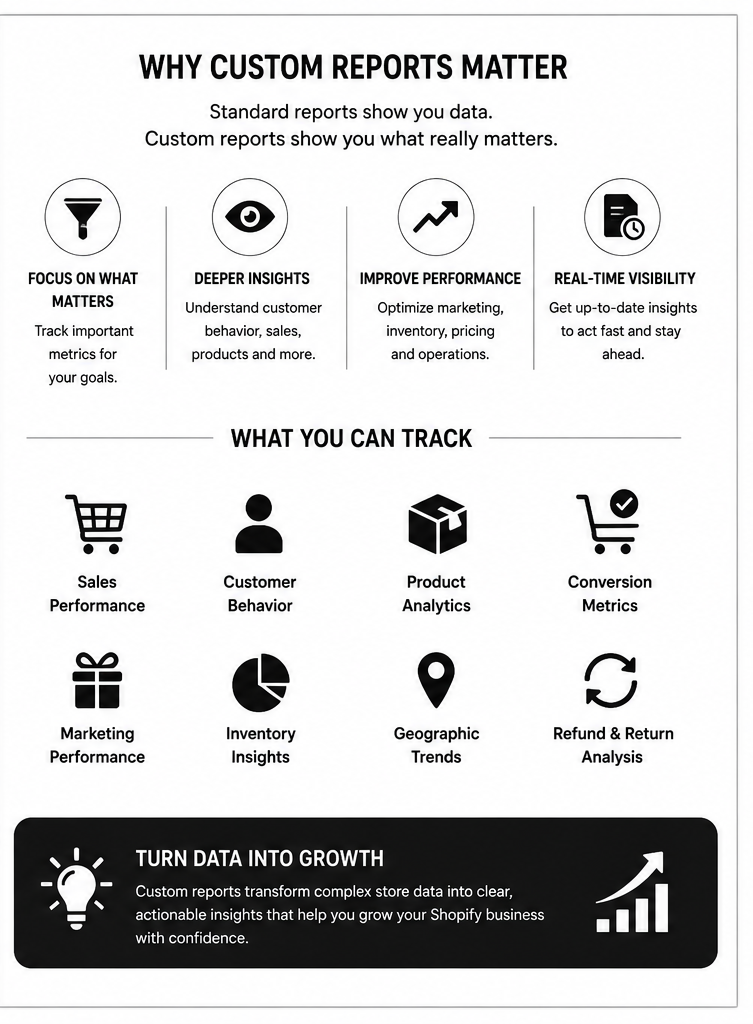
Instead of relying only on standard reports, custom reporting allows businesses to organize store information according to their unique goals, priorities, and operational needs. It helps store owners move beyond generic analytics and focus on the metrics that truly impact growth.
Modern eCommerce businesses are increasingly shifting toward personalized reporting systems because every store operates differently. Different products, customer behaviors, pricing strategies, and marketing channels require different insights.
Custom reports make that possible.
Understanding the Role of Custom Reporting in Shopify
Most Shopify stores generate large amounts of data every single day.
This data may include:
- Sales performance
- Customer activity
- Product trends
- Inventory movement
- Traffic sources
- Refund behavior
- Conversion patterns
- Marketing performance
- Shipping activity
While standard analytics provide basic visibility, they often fail to answer business-specific questions.
For example:
- Which products generate the highest long-term profitability?
- Which customer segments create the most repeat purchases?
- Which marketing campaigns attract high-value buyers?
- Which products experience seasonal demand spikes?
- Which regions generate the best conversion rates?
Generic reports may provide partial answers, but custom reports allow businesses to organize information according to their exact objectives.
This creates clearer decision-making and better operational control.
Why Modern Shopify Businesses Need Custom Reports
As Shopify businesses grow, operations become more complex.
More products, more customers, and more marketing channels create larger amounts of information that can quickly become difficult to manage.
Without customized reporting, businesses often face problems such as:
- Information overload
- Reporting confusion
- Delayed decision-making
- Fragmented analytics
- Difficulty identifying growth opportunities
Many businesses spend hours manually organizing spreadsheets or comparing multiple reports just to understand basic performance trends.
This slows down operations and increases the risk of mistakes.
Custom reports solve this problem by simplifying information into meaningful business insights.
Instead of searching for answers manually, businesses can focus directly on improving performance.
Moving Beyond Standard Store Analytics
Standard analytics are useful for general visibility, but modern businesses require deeper understanding.
Custom reports help businesses go beyond surface-level metrics.
For example, instead of only viewing total sales, businesses can analyze:
- Revenue by customer type
- Profitability by product category
- Sales performance by region
- Repeat purchase trends
- Conversion rates by traffic source
- Customer retention patterns
This level of detail creates a more strategic understanding of business performance.
The focus shifts from simply tracking activity to understanding why results happen.
And that difference is what creates smarter business decisions.
Personalized Reporting for Different Business Goals
Every Shopify business operates differently.
Some stores focus on high-volume sales.
Others prioritize customer retention.
Some businesses focus on subscription models.
Others depend heavily on seasonal promotions.
Because of this, reporting requirements vary significantly.
Custom reports allow businesses to track the metrics most relevant to their goals.
For example:
Growth-Focused Stores
These businesses may prioritize:
- Customer acquisition trends
- Conversion growth
- Marketing performance
- Average order value
Profit-Focused Businesses
These stores may focus more on:
- Product profitability
- Operational costs
- Refund impact
- Inventory efficiency
Retention-Focused Brands
These businesses may prioritize:
- Repeat purchase rates
- Customer lifetime value
- Loyalty trends
- Customer engagement behavior
Custom reporting ensures that businesses focus on the information that matters most to them.
Better Visibility Leads to Faster Decisions
One of the biggest advantages of custom reports is improved visibility.
When information is organized clearly, businesses can identify trends much faster.
For example:
- A sudden drop in conversions becomes immediately visible
- Slow-moving inventory can be identified early
- Marketing campaigns can be adjusted quickly
- Product demand changes can be monitored in real time
This speed improves business agility.
Instead of reacting too late, businesses can respond proactively.
In eCommerce, faster decisions often create stronger competitive advantages.
Simplifying Complex Data
One major challenge in Shopify analytics is complexity.
Raw store data can be overwhelming, especially for businesses without technical expertise.
Custom reports simplify this complexity by transforming large datasets into clear business summaries.
Instead of reviewing endless spreadsheets, businesses can access:
- Organized dashboards
- Focused performance summaries
- Clear trend analysis
- Actionable insights
This makes analytics easier to understand for:
- Business owners
- Marketing teams
- Operations managers
- Sales teams
- Customer support departments
Clear reporting improves collaboration across the organization.
Improving Sales Performance Through Reporting
Sales analytics become significantly more powerful when customized properly.
Instead of only tracking revenue totals, businesses can understand:
- Which products consistently perform best
- Which product bundles increase order value
- Which discounts improve profitability
- Which promotions generate long-term customer value
This helps businesses optimize:
- Pricing strategies
- Product positioning
- Upselling opportunities
- Promotional campaigns
Sales decisions become more strategic instead of reactive.
Understanding Customer Behavior More Deeply
Customer insights are one of the strongest benefits of custom reporting.
Modern businesses need more than basic purchase history.
They need to understand:
- Buying habits
- Shopping frequency
- Product preferences
- Retention behavior
- Checkout abandonment patterns
Custom reports help businesses identify valuable customer segments and improve customer experiences accordingly.
For example:
- Loyal customers can receive personalized offers
- High-value customers can be prioritized
- At-risk customers can be re-engaged
- Product recommendations can become more relevant
This creates stronger customer relationships and higher long-term revenue.
Inventory Management Becomes Smarter
Inventory management is one of the most critical operational areas in eCommerce.
Poor inventory visibility can create:
- Overstocking
- Stock shortages
- Cash flow pressure
- Lost sales opportunities
Custom inventory reports help businesses track:
- Fast-selling products
- Slow-moving stock
- Seasonal demand changes
- Product return patterns
- Inventory turnover rates
This improves purchasing decisions and operational planning.
Businesses can maintain healthier inventory levels while reducing unnecessary expenses.
Marketing Optimization Through Custom Analytics
Marketing performance becomes much easier to evaluate with custom reports.
Businesses can analyze:
- Traffic quality
- Campaign conversion rates
- Customer acquisition costs
- Revenue by marketing channel
- Return on advertising spend
This helps businesses understand which marketing efforts actually create profitable growth.
Instead of relying on assumptions, decisions become data-driven.
Marketing budgets can be allocated more efficiently, improving overall profitability.
Real-Time Reporting Improves Agility
Modern eCommerce moves quickly.
Customer behavior, sales trends, and market demand can change within hours.
Custom reports with real-time visibility help businesses stay responsive.
This allows businesses to:
- Monitor live sales performance
- Track active promotions
- Respond to sudden demand spikes
- Identify operational issues early
Real-time visibility reduces delays and improves decision-making confidence.
Businesses become more adaptable in fast-changing markets.
Reducing Manual Work and Reporting Fatigue
Many Shopify businesses spend excessive time creating reports manually.
This often involves:
- Exporting spreadsheets
- Organizing data manually
- Comparing multiple reports
- Updating analytics repeatedly
Manual reporting creates inefficiency and increases the risk of errors.
Custom reports automate much of this process by organizing information automatically.
This saves time and allows teams to focus more on strategy and growth instead of repetitive reporting tasks.
Better Reporting Creates Better Leadership
Strong business leadership depends on clarity.
When decision-makers understand store performance clearly, they can:
- Plan growth more confidently
- Allocate resources effectively
- Identify risks earlier
- Improve operational efficiency
Without reliable reporting, businesses often rely too heavily on assumptions.
Custom reporting reduces uncertainty by providing structured visibility into business performance.
This creates stronger strategic planning and more confident leadership.
Scaling Shopify Businesses with Better Analytics
As Shopify stores grow, data complexity naturally increases.
Small reporting systems that once worked may become inefficient over time.
More orders, products, and customer interactions create larger operational pressure.
Custom reporting helps businesses scale more effectively by maintaining:
- Organized analytics
- Clear operational visibility
- Consistent performance tracking
- Faster reporting processes
This ensures that growth does not create confusion.
Instead, businesses maintain clarity even as operations expand.
The Shift Toward Data-Driven ECommerce
The future of eCommerce is increasingly data-driven.
Businesses are moving away from intuition-based decision-making and focusing more on evidence-based strategies.
Custom reporting plays a major role in this transformation.
It allows businesses to:
- Identify growth opportunities earlier
- Improve operational efficiency
- Increase customer satisfaction
- Reduce unnecessary costs
- Make faster strategic decisions
Data becomes more than information.
It becomes a business advantage.
Why Simplicity Matters in Modern Reporting
One important trend in modern analytics is simplicity.
Businesses no longer want overly complicated reporting systems that require technical expertise to understand.
The most effective reporting systems are often:
- Easy to access
- Easy to understand
- Focused on meaningful insights
- Designed for fast action
Simplicity improves usability across the organization.
When teams can understand analytics quickly, decision-making becomes faster and more effective.
Final Thoughts
Shopify custom reports are transforming how modern eCommerce businesses understand and manage their operations.
Instead of relying on generic analytics, businesses can create reporting systems aligned with their unique goals, workflows, and growth strategies.
Custom reporting improves:
- Business visibility
- Customer understanding
- Inventory management
- Marketing performance
- Sales optimization
- Operational efficiency
Most importantly, it helps businesses make smarter decisions with greater confidence.
In today’s competitive eCommerce environment, success is no longer about collecting the most data.
It is about understanding the right data clearly and using it strategically.
Because businesses that can turn information into action will always outperform businesses that simply collect numbers.