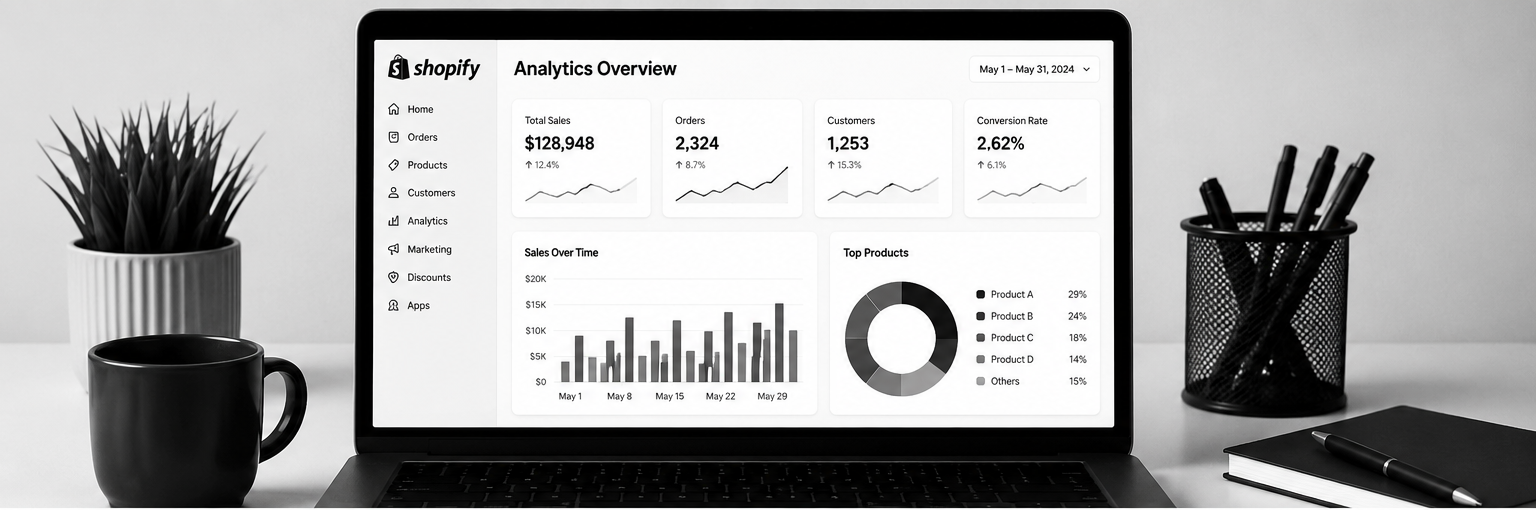
Why Shopify Store Owners Are Drowning in Data
Modern Shopify businesses are generating more data than ever before.
Every customer click, product view, abandoned cart, completed order, refund request, inventory update, email campaign, and shipping status creates valuable business information. On the surface, this sounds like a huge advantage for store owners.
More data should mean smarter decisions.
More visibility.
More growth opportunities.
But for many Shopify businesses, the reality looks very different.
Instead of creating clarity, the explosion of data is creating confusion.
Store owners are overwhelmed by endless reports, disconnected dashboards, spreadsheets, marketing metrics, operational updates, customer behavior analytics, and sales tracking systems. Businesses are surrounded by information, yet many still struggle to answer simple operational questions quickly.
This is why so many Shopify store owners today feel like they are drowning in data.
The problem is no longer a lack of information.
The real challenge is understanding which information actually matters.
The Shopify Data Explosion
In the early days of eCommerce, businesses tracked only a small number of metrics:
- Daily sales
- Order counts
- Basic customer information
- Inventory levels
Modern Shopify stores are very different.
Today’s businesses track:
- Traffic sources
- Customer journeys
- Product engagement
- Conversion rates
- Cart abandonment
- Repeat purchases
- Marketing performance
- Customer retention
- Inventory movement
- Shipping behavior
- Mobile activity
- Geographic trends
- Profitability metrics
Every operational area now produces its own stream of data.
While this creates powerful business opportunities, it also introduces overwhelming complexity.
Many store owners spend more time trying to organize information than actually using it to improve business performance.
Too Many Reports, Too Little Clarity
One of the biggest frustrations Shopify businesses face is report overload.
Businesses often manage:
- Sales reports
- Product reports
- Customer reports
- Inventory reports
- Marketing analytics
- Financial summaries
- Shipping performance reports
- Operational dashboards
Each report provides information, but not always understanding.
Store owners constantly switch between systems trying to piece together a complete view of business performance.
This creates mental overload.
Instead of simplifying decision-making, excessive reporting often makes decisions harder.
Businesses struggle to identify:
- Which metrics truly matter
- Which problems require immediate attention
- Which opportunities deserve focus
More information does not automatically create more clarity.
Data Without Context Creates Confusion
Numbers alone rarely tell the full story.
For example:
- High traffic may not mean strong sales
- Rising revenue may hide shrinking profit margins
- Increased orders may create operational pressure
- Popular products may generate high return rates
Without context, data becomes misleading.
Many Shopify store owners see large volumes of information but struggle to interpret what it actually means for the business.
This creates uncertainty.
Businesses know the data exists, but they often lack operational visibility that transforms information into meaningful business direction.
Store Owners Are Forced to Become Analysts
One major reason Shopify businesses feel overwhelmed is because store owners are increasingly expected to analyze large amounts of operational data themselves.
Many entrepreneurs started businesses because they wanted to:
- Build brands
- Sell products
- Serve customers
- Create better shopping experiences
They did not start businesses to spend hours analyzing spreadsheets and dashboards every day.
But modern eCommerce operations often push store owners into constant reporting and data management responsibilities.
This creates operational fatigue.
Instead of focusing on growth and customers, many businesses spend excessive time trying to organize information.
Data Fragmentation Makes Everything Harder
Modern Shopify operations often rely on multiple platforms and workflows.
Businesses manage information across:
- Store operations
- Marketing channels
- Customer communication systems
- Inventory management
- Financial tracking
- Shipping systems
The problem is that these systems frequently operate independently.
Important business information becomes fragmented across disconnected platforms.
This creates several operational challenges:
- Inconsistent reporting
- Duplicate work
- Delayed insights
- Communication gaps
- Decision-making confusion
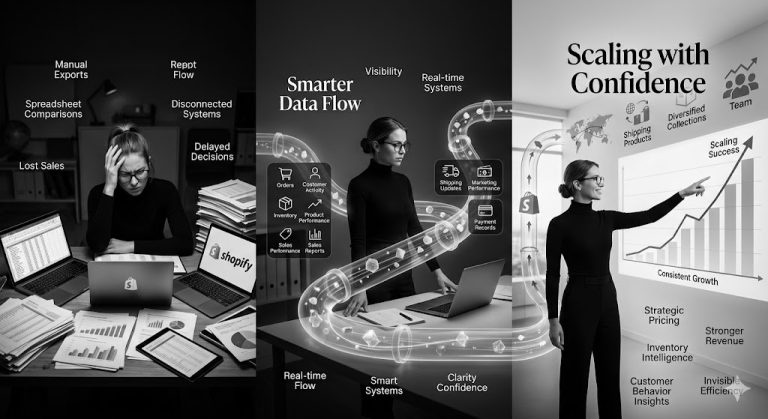
Store owners waste valuable time trying to combine information manually instead of acting on insights quickly.
The Pressure to Track Everything
Modern eCommerce culture often encourages businesses to monitor every possible metric.
Businesses are told to track:
- Click-through rates
- Bounce rates
- Session duration
- Customer acquisition costs
- Lifetime value
- Cart recovery
- Product engagement
- Email open rates
- Social media performance
- Conversion funnels
While these metrics can be useful, excessive monitoring creates information overload.
Many Shopify businesses begin tracking data simply because it is available—not because it supports better decisions.
This creates operational noise.
Businesses lose focus on the insights that actually improve performance.
Spreadsheet Dependency Creates Operational Fatigue
Many Shopify businesses still rely heavily on spreadsheets for reporting and analysis.
At first, spreadsheets feel manageable.
But as stores grow, spreadsheet management becomes increasingly exhausting.
Teams spend hours:
- Exporting reports manually
- Updating data daily
- Organizing sales information
- Comparing metrics
- Fixing formatting issues
- Searching for missing data
This repetitive administrative work drains productivity.
Instead of helping businesses grow faster, manual reporting slows operations down.
Store owners become trapped inside operational maintenance instead of strategic growth planning.
Data Delays Slow Down Decision-Making
One of the biggest hidden problems in Shopify operations is delayed visibility.
Businesses often react too slowly because important insights arrive late.
For example:
- Inventory shortages may go unnoticed
- Product performance declines may appear too late
- Customer retention issues may continue for months
- Marketing inefficiencies may drain budgets quietly
Without fast operational visibility, businesses struggle to respond quickly.
This weakens agility.
In modern eCommerce, delayed decisions can become expensive decisions.
Customer Behavior Is Becoming More Complex
Today’s customers interact with Shopify stores in highly unpredictable ways.
Customers may:
- Browse on mobile
- Purchase later on desktop
- Visit multiple times before buying
- Respond differently to promotions
- Abandon carts unexpectedly
- Compare multiple products before checkout
Understanding these behaviors requires businesses to process large amounts of customer activity data.
This complexity creates another layer of operational pressure.
Businesses collect enormous amounts of customer information but often struggle to identify the behaviors that truly matter.
Businesses Confuse Data Collection With Strategy
Many Shopify businesses believe collecting more information automatically improves performance.
But data collection is not the same as strategy.
Some businesses continuously gather reports without actually improving operational decision-making.
This creates a dangerous cycle:
- More reports
- More dashboards
- More spreadsheets
- More confusion
- Less clarity
The goal should not be endless data accumulation.
The goal should be actionable business understanding.
Businesses grow stronger when they focus on meaningful insights instead of excessive information.
Operational Complexity Increases as Stores Scale
Small Shopify stores can often manage operations manually.
But growth changes everything.
As businesses scale, they experience:
- Higher order volumes
- Larger inventories
- More customer interactions
- Expanded product catalogs
- Additional sales channels
- More marketing campaigns
This operational growth multiplies the amount of business data dramatically.
Without simplified systems and organized visibility, businesses quickly become overwhelmed.
What once felt manageable becomes operational chaos.
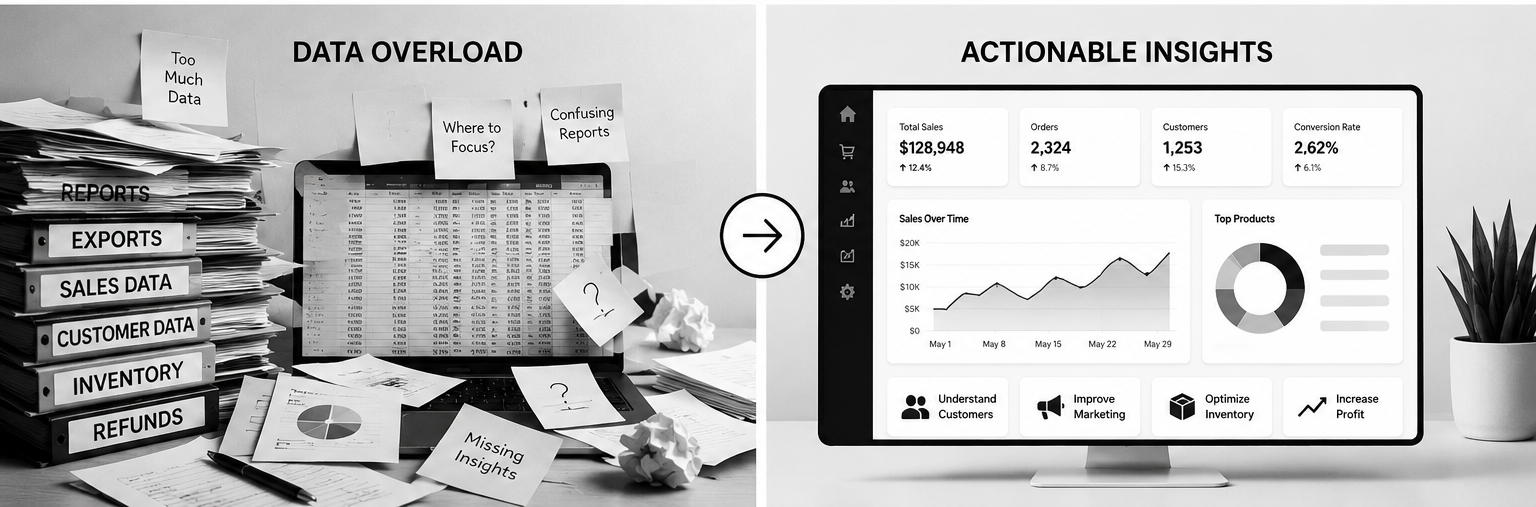
Data Anxiety Is Becoming Common in E-commerce
Many Shopify store owners experience a constant sense of operational pressure because they fear missing important insights.
They worry about:
- Hidden performance problems
- Missed growth opportunities
- Marketing inefficiencies
- Customer dissatisfaction
- Inventory mistakes
- Profitability declines
This creates data anxiety.
Businesses feel surrounded by information but uncertain about where to focus attention.
Too much data without prioritization creates stress instead of confidence.
Businesses Need Simplicity More Than Ever
The solution to data overload is not more information.
The solution is simplicity.
Modern Shopify businesses increasingly need:
- Clear operational visibility
- Simplified reporting
- Faster insights
- Actionable intelligence
- Smarter workflows
Businesses do not need endless numbers.
They need systems that help them quickly understand:
- What matters most
- What requires action
- What drives growth
- What creates operational risk
Simplicity improves operational focus.
And focused businesses make better decisions faster.
Visibility Creates Better Leadership
Strong business leadership depends on clarity.
Without organized visibility, even experienced Shopify store owners hesitate during important decisions.
Questions become harder to answer:
- Which products deserve investment?
- Which campaigns should scale?
- Which customers drive long-term value?
- Which operational areas need improvement?
Too much disconnected information creates uncertainty.
Simplified operational visibility improves leadership confidence.
Businesses move faster when they understand their business more clearly.
Automation Is Becoming Essential
As Shopify operations become more complex, manual workflows are becoming increasingly unsustainable.
Businesses can no longer rely entirely on:
- Manual exports
- Spreadsheet management
- Repetitive reporting
- Constant dashboard monitoring
Automation is becoming necessary to reduce operational overload.
Smarter workflows help businesses:
- Save time
- Reduce human error
- Improve visibility
- Increase efficiency
- Focus more on growth
The future of eCommerce operations depends heavily on simplifying how businesses manage information.
The Most Successful Businesses Focus on Actionable Insights
The fastest-growing Shopify businesses are not necessarily the ones with the most data.
They are often the businesses that:
- Understand customers clearly
- Identify important trends quickly
- Simplify operations effectively
- Focus on high-value insights
- Reduce operational complexity
These businesses avoid drowning in information because they prioritize clarity over quantity.
They focus on actionable intelligence rather than endless reporting.
The Future of Shopify Operations Will Prioritize Clarity
The future of Shopify operations is moving toward:
- Simpler workflows
- Faster visibility
- Real-time insights
- Smarter operational systems
- Reduced administrative workload
Businesses are beginning to recognize that operational simplicity is a major competitive advantage.
The goal is no longer collecting more information.
The goal is understanding what truly matters and acting on it quickly.
Final Thoughts
Modern Shopify businesses are surrounded by more data than ever before.
While this information creates enormous growth potential, it also introduces significant operational complexity.
Many store owners feel overwhelmed because they are managing:
- Too many reports
- Disconnected systems
- Endless spreadsheets
- Delayed insights
- Constant operational monitoring
The problem is not the existence of data.
The problem is the lack of clarity.
Businesses do not need more information.
They need better understanding.
The future of successful Shopify operations depends on simplifying visibility, reducing operational overload, and focusing on actionable insights instead of endless reporting.
Because the businesses that grow strongest are not the ones drowning in data.
They are the businesses that can transform complexity into clarity and turn clear insights into smarter business decisions.