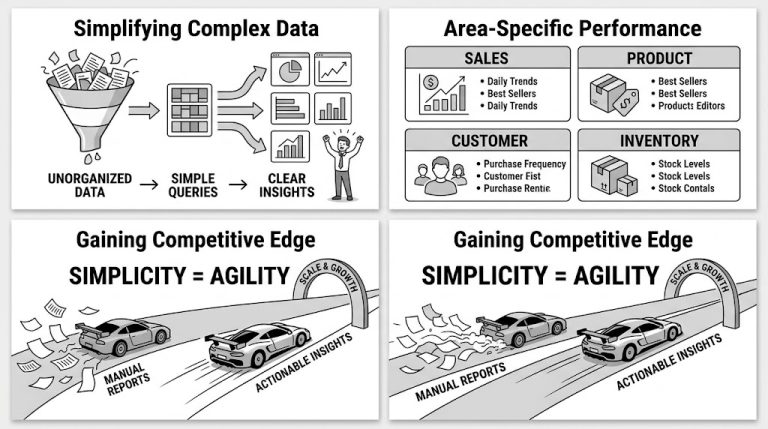
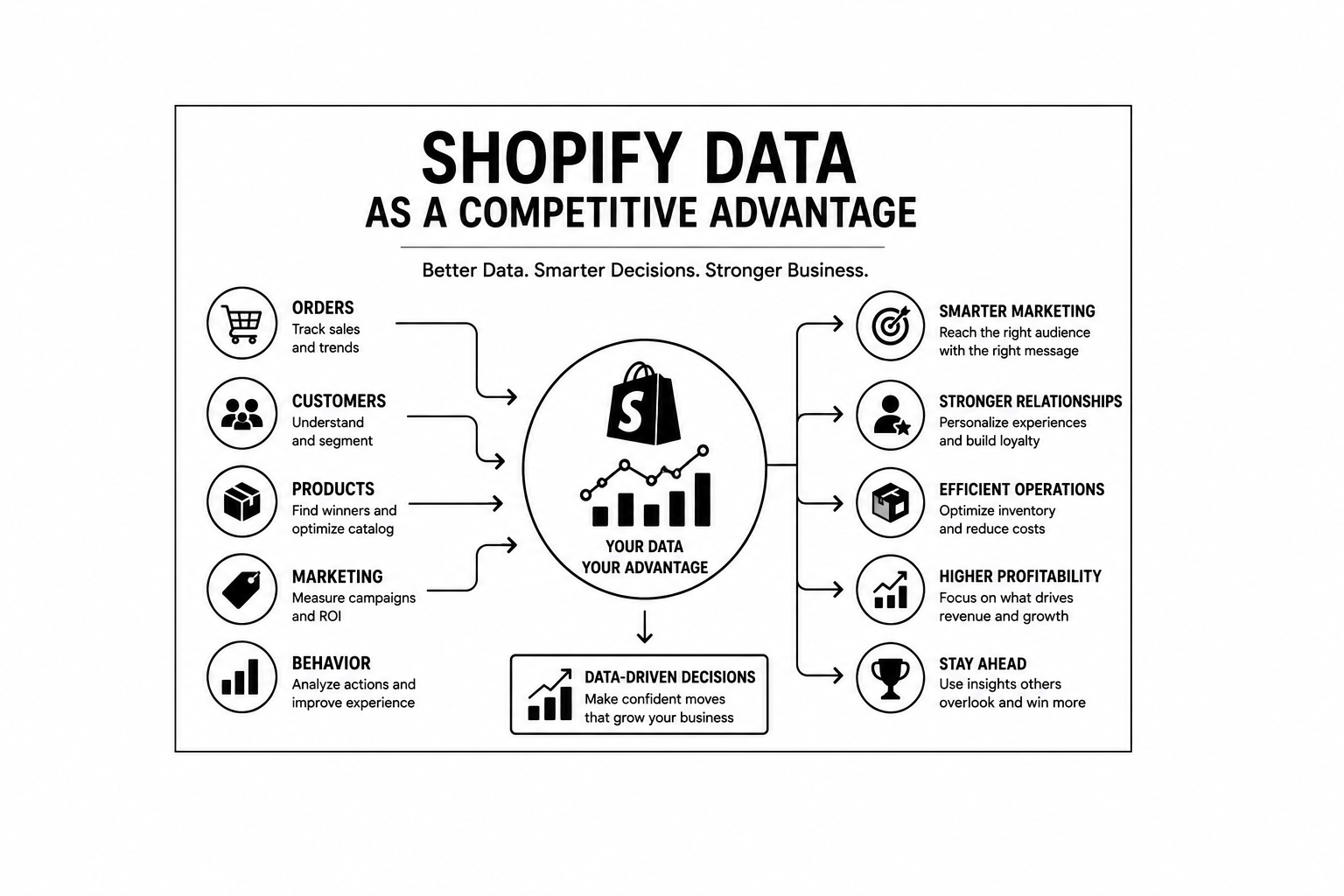
Shopify Data as a Competitive Advantage
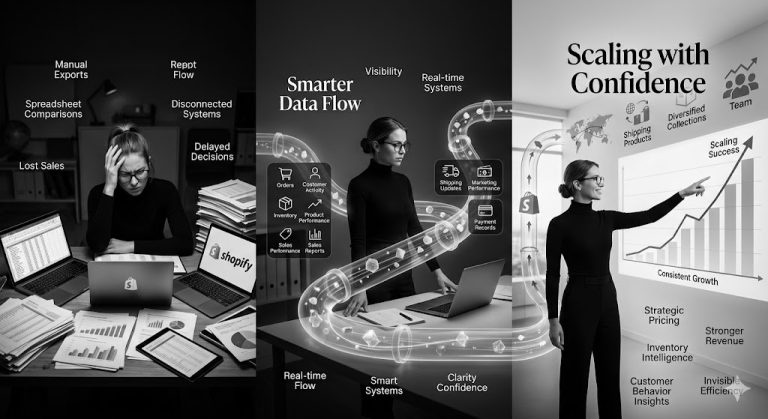
In today’s e-commerce world, products alone are no longer enough to guarantee success. Thousands of Shopify stores may sell similar products, target the same audience, and even run similar marketing campaigns. Yet some brands grow rapidly while others struggle to survive.
The difference often comes down to one thing: how they use data.
Modern e-commerce is no longer driven only by creativity or advertising budgets. It is driven by insights. The businesses growing the fastest are the ones that understand their customers deeply, identify trends early, and make smarter decisions based on real information instead of assumptions.
This is why Shopify data has become one of the biggest competitive advantages in online business.
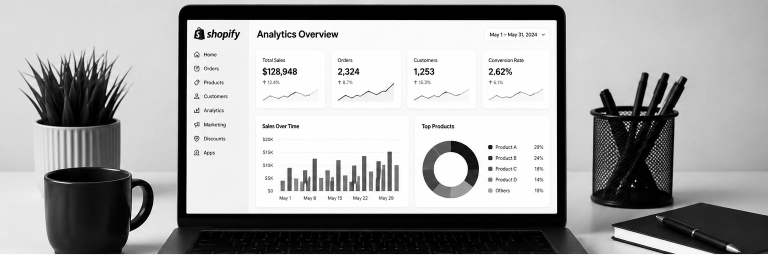
Data is no longer just numbers sitting inside a dashboard—it is a strategic asset that can influence every part of a store’s growth, from marketing and inventory to customer retention and profitability.
Understanding the Real Value of Shopify Data
Every action inside a Shopify store creates data.
When customers:
- Visit product pages
- Add items to cart
- Make purchases
- Abandon checkout
- Return for repeat orders
they generate valuable information.
At first glance, this may look like simple store activity. But hidden inside this information are patterns, behaviors, and opportunities that can completely change how a business operates.
Successful stores don’t just collect data—they learn from it.
They use it to answer questions like:
- Which products generate the highest profit?
- Why are customers leaving before checkout?
- Which marketing campaigns actually convert?
- What products should be promoted next month?
The answers to these questions create a powerful advantage over competitors who rely on guesswork.
The Shift from Guessing to Data-Driven Decisions
Many businesses still operate based on assumptions:
- “This product should perform well.”
- “This ad probably works.”
- “Customers may like this design.”
But assumptions are risky.
Data-driven businesses operate differently. They test, analyze, and optimize continuously.
Instead of asking:
- “What do we think customers want?”
They ask:
- “What does the data show customers actually want?”
This shift changes everything.
It reduces costly mistakes, improves efficiency, and increases confidence in decision-making.
Data Creates Smarter Marketing Strategies
Marketing is one of the most competitive areas in e-commerce.
Without data, businesses often waste money targeting the wrong audience or promoting the wrong products.
Shopify data changes this completely.
By analyzing customer behavior, businesses can identify:
- Which campaigns generate sales
- Which audiences convert best
- Which products attract repeat buyers
- Which channels bring the highest-value customers
This allows businesses to focus their budget where it matters most.
For example:
- If one product consistently converts well through social media traffic, marketing efforts can be concentrated there
- If certain customers repeatedly buy premium products, businesses can create personalized offers for them
Marketing becomes strategic instead of random.
Understanding Customers Better Than Competitors
One of the biggest competitive advantages comes from customer understanding.
Most businesses know who buys from them.
Smart businesses know:
- Why customers buy
- When they buy
- What they buy together
- How often they return
This deeper understanding allows brands to create personalized experiences.
For example:
- Loyal customers can receive exclusive offers
- High-spending buyers can receive premium recommendations
- Inactive customers can receive re-engagement campaigns
Personalization increases trust, customer satisfaction, and repeat purchases.
And in modern e-commerce, customer loyalty is incredibly valuable.
Product Decisions Become More Accurate
Without data, product decisions are often emotional.
Businesses may continue promoting products simply because they personally like them.
But data reveals the truth.
By analyzing store performance, businesses can identify:
- Best-selling products
- Low-performing items
- Seasonal trends
- High-profit categories
This allows stores to:
- Focus on winning products
- Improve weak product listings
- Remove underperforming inventory
For example:
A product may receive many views but very few purchases. This signals a problem with pricing, images, or descriptions.
Without data, this issue may go unnoticed.
With data, it becomes a clear opportunity for optimization.
Faster Decision-Making Creates Competitive Speed
Speed matters in e-commerce.
Trends change quickly. Customer behavior changes quickly. Competitors move quickly.
Businesses that rely on outdated information react too slowly.
Data-driven stores have a major advantage because they can:
- Spot trends early
- Identify problems immediately
- Adjust marketing campaigns faster
- Restock popular products quickly
This operational speed creates a significant edge over slower competitors.
For example:
If a product suddenly starts trending, a data-driven business can immediately increase promotions and inventory before competitors even notice the trend.
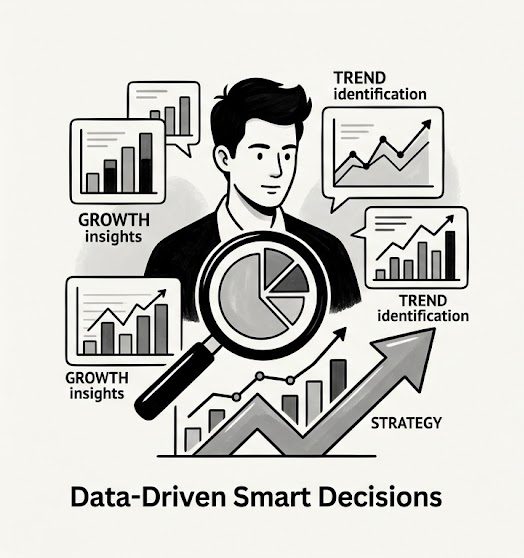
Inventory Management Becomes More Efficient
Inventory problems are expensive.
Too much stock ties up money.
Too little stock leads to lost sales.
Shopify data helps businesses find balance.
By analyzing:
- Product demand
- Sales frequency
- Seasonal trends
- Purchase patterns
businesses can forecast inventory more accurately.
This leads to:
- Better cash flow
- Lower storage costs
- Reduced stock shortages
- Improved customer satisfaction
Inventory becomes strategic instead of reactive.
Customer Retention Becomes Easier
Acquiring new customers is expensive.
Retaining existing customers is far more profitable.
Data helps businesses understand:
- Which customers are likely to return
- Which customers are becoming inactive
- Which products encourage repeat purchases
This allows brands to build stronger customer relationships.
For example:
- Repeat customers can receive loyalty rewards
- Customers who haven’t purchased recently can receive targeted reminders
- Buyers can receive recommendations based on past purchases
This creates a more personalized shopping experience that competitors may struggle to match.
Data Reveals Hidden Opportunities
One of the most powerful aspects of data is that it often reveals opportunities businesses never expected.
For example:
- A product unexpectedly becomes popular in a certain region
- Customers frequently purchase two products together
- A small category starts growing rapidly
These insights can lead to:
- New marketing campaigns
- Product bundles
- Regional targeting strategies
- Expansion opportunities
Businesses that pay attention to data often discover growth opportunities earlier than competitors.
Reporting and Visibility Improve Leadership
As businesses grow, operations become more complex.
Leaders need clear visibility into:
- Revenue trends
- Product performance
- Customer behavior
- Marketing efficiency
Without organized reporting, decision-making becomes difficult.
Shopify data provides clarity.
Instead of relying on instinct, business leaders can:
- Measure performance accurately
- Track growth consistently
- Identify weak areas quickly
This creates stronger business management overall.
Competitive Advantage Is No Longer Just About Price
Many businesses try competing through discounts and low pricing.
But this strategy is difficult to sustain.
Data-driven businesses compete differently.
They compete through:
- Better customer experience
- Faster adaptation
- Smarter marketing
- More accurate inventory management
- Personalized engagement
These advantages are much harder for competitors to copy.
Data Builds Long-Term Business Strength
Short-term success can come from:
- Viral products
- Temporary trends
- Aggressive advertising
But long-term growth requires systems.
Data helps businesses build repeatable systems for:
- Marketing optimization
- Customer retention
- Inventory planning
- Product strategy
This creates stability and scalability.
Businesses become less dependent on luck and more dependent on informed strategy.
Common Mistakes Businesses Make with Data
Even though data is valuable, many stores fail to use it properly.
1. Collecting Data Without Analysis
Information is useless if businesses never review it.
2. Focusing Only on Sales
Revenue matters, but customer behavior and retention matter too.
3. Ignoring Small Trends
Small changes often reveal major future opportunities.
4. Delayed Decision-Making
Data loses value if businesses react too slowly.
The Future of Competitive E-commerce
E-commerce is becoming increasingly data-driven.
In the future, successful stores will rely even more on:
- Predictive insights
- Personalized shopping experiences
- Automated optimization
- Real-time decision-making
Businesses that understand data early will gain a huge advantage.
Those who ignore it may struggle to keep up.
Final Thoughts
Shopify data is no longer just a collection of reports and numbers. It is one of the most powerful competitive advantages an online business can have.
It helps businesses:
- Understand customers deeply
- Make smarter decisions
- Improve marketing efficiency
- Optimize inventory
- Increase customer loyalty
- Adapt faster than competitors
In modern e-commerce, the stores that win are not always the ones with the biggest budgets or the largest product catalogs.
They are the ones that understand their data, act on insights quickly, and continuously improve based on real information.
Because in today’s competitive digital landscape, data is not just support for business growth—it is the strategy behind it.