Why the Fastest-Growing Shopify Stores Think Differently About Data
In the world of e-commerce, two Shopify stores can start in almost the same way—same platform, similar products, comparable budgets—but end up in completely different places within a year. One struggles to grow beyond a few sales a day, while the other scales rapidly, builds a loyal customer base, and becomes highly profitable.
The difference is rarely luck. It is almost always how they think about data.
Fast-growing Shopify stores don’t treat data as a background report or a monthly summary. They treat it as the core decision-making engine of their entire business. Every product launch, marketing campaign, pricing change, and customer interaction is influenced by what their data is telling them.
Let’s break down how these high-growth stores think differently—and what sets them apart.
1. They Don’t See Data as Numbers, They See It as Behavior
Most beginners look at Shopify data and see numbers:
- 120 orders
- 3,500 visitors
- 2.5% conversion rate
But fast-growing stores see something deeper.
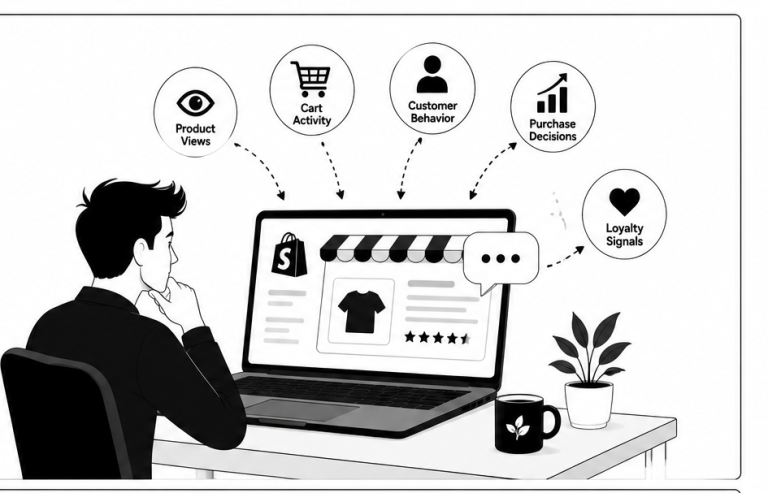
They see behavior patterns:
- Why are people leaving the checkout page?
- Which product is creating repeat purchases?
- What time of day are customers most active?
- What kind of visitors are actually converting?
Instead of asking “How many sales did we make?”, they ask:
“What caused those sales?”
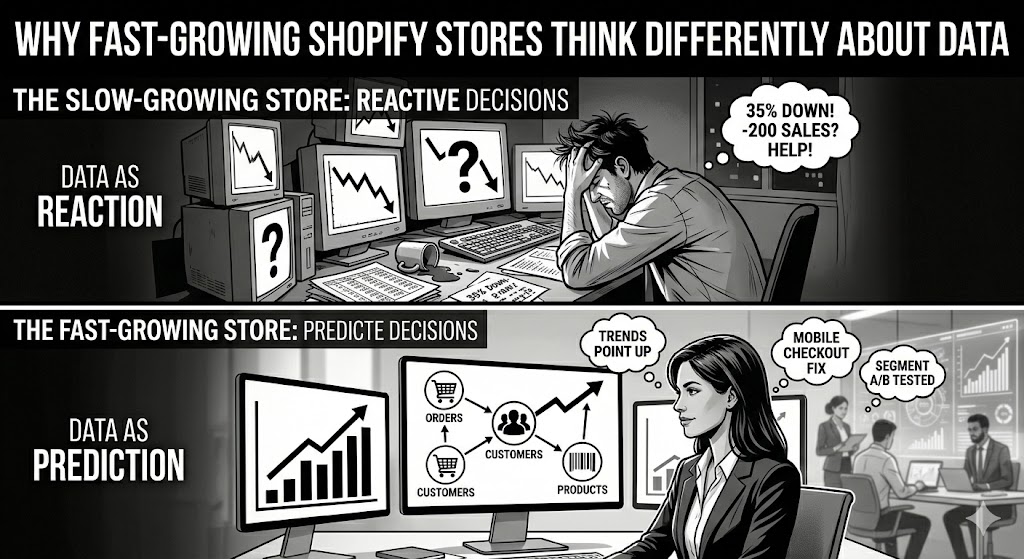
This shift in thinking is powerful because it moves the business from reactive to predictive.
For example, if a store notices that mobile users are abandoning checkout more often than desktop users, they don’t just accept it as a stat. They investigate the reason behind the behavior—slow loading pages, confusing layout, or payment issues.
That mindset alone can dramatically increase revenue.
2. They Focus on Trends, Not One-Time Results
Slow-growing stores often get excited about isolated spikes:
- A viral product
- A successful ad campaign
- A weekend sale
But fast-growing Shopify stores ignore short-term excitement and focus on long-term patterns.
They track:
- Weekly and monthly sales trends
- Customer repeat purchase rates
- Seasonal product performance
- Traffic source consistency
Instead of saying “We made a lot this week,” they ask:
“Is this growth consistent or temporary?”
For example, a product might sell 200 units in one week due to a discount. But smart stores check whether it continues selling after the discount ends. If it doesn’t, they know the product is not organically strong.
This helps them avoid false confidence and build stable growth systems.
3. They Treat Customers as Data, Not Just Buyers
One of the biggest differences is how they think about customers.
Low-growth stores see a customer as a single transaction:
- Order placed
- Payment received
- Product shipped
Fast-growing stores see customers as ongoing data points.
They analyze:
- Lifetime value of each customer
- Frequency of repeat purchases
- Product combinations bought together
- Geographic and demographic patterns
This helps them build customer segments, such as:
- High-value repeat buyers
- Discount-driven buyers
- First-time one-time buyers
- Loyal brand advocates
Once segmented, they stop marketing to everyone the same way. Instead, they send targeted offers.
For example:
- A loyal customer gets early access to new products
- A one-time buyer gets a comeback discount
- A high-spending customer gets premium bundles
This personalization increases both trust and revenue.
4. They Use Data to Kill Weak Products Quickly
One major difference between average and fast-growing stores is product decision speed.
Slow stores hold onto products too long, hoping they will improve.
Fast-growing stores do the opposite—they remove underperforming products quickly.
They track:
- Conversion rate per product
- Add-to-cart rate
- Return rate
- Profit margin per item
If a product consistently underperforms, they don’t emotionally attach to it. They remove it or reposition it.
This creates space for better products to scale.
For example, if 10 products are listed but only 3 are generating 80% of revenue, smart stores shift focus entirely to those 3 and optimize them further.
This discipline is a major growth accelerator.
5. They Don’t Guess Marketing—They Measure Everything
In slow-growing stores, marketing decisions are often based on assumptions:
- “This ad looks good”
- “This influencer seems popular”
- “Let’s try this campaign”
Fast-growing stores never rely on guessing.
They measure everything:
- Cost per click
- Conversion rate per campaign
- Return on ad spend
- Customer acquisition cost
- Email open and click rates
They constantly ask:
“Is this marketing activity profitable or not?”
Even creative decisions are data-backed. For example, they test multiple ad designs and only scale the one that performs best.
Instead of one big gamble, they run many small experiments and let data decide the winner.
6. They Think in Funnels, Not Just Sales
Another major difference is how they view the customer journey.
Slow stores focus only on the final sale.
Fast-growing stores analyze the entire funnel:
- Website visit
- Product page view
- Add to cart
- Checkout initiation
- Purchase completion
At each stage, they track drop-offs.
For example:
- If many users visit but don’t add to cart, product pages may need improvement
- If users add to cart but don’t purchase, checkout experience may be the issue
This allows them to fix weak points instead of blindly trying to increase traffic.
They understand a simple truth:
More traffic does not fix a broken funnel. Optimization does.
7. They Make Decisions Faster Because Data Is Always Available
Speed is a competitive advantage in e-commerce.
Fast-growing Shopify stores don’t wait for monthly reports. They check performance daily or even in real time.
Because data is always accessible, they can:
- Pause underperforming ads immediately
- Restock trending products quickly
- Launch promotions based on live demand
- Adjust pricing when necessary
This speed helps them stay ahead of competitors who react too slowly.
In e-commerce, timing often matters as much as strategy.
8. They Combine Data with Creativity, Not Replace It
A common misconception is that data kills creativity. Fast-growing stores prove the opposite.
They don’t use data instead of creativity—they use it to guide creativity.
For example:
- Data shows customers prefer minimal designs → creative team builds cleaner product pages
- Data shows certain colors sell better → designers prioritize those styles
- Data shows mobile traffic is dominant → UI is designed mobile-first
This balance ensures that creativity is not random but purposeful.
The result is marketing that looks good and performs well.
9. They Continuously Ask Better Questions
The biggest shift is not tools or dashboards—it is questioning.
Slow stores ask:
- “How much did we sell?”
Fast stores ask:
- “Why did customers buy?”
- “What made them leave?”
- “What will make them return?”
- “What can we improve next?”
Better questions lead to better insights.
Over time, this builds a culture where every decision is backed by curiosity and evidence.
10. They Build Systems, Not Just Campaigns
Slow-growing stores often rely on one-time efforts:
- A big discount sale
- A viral product
- A single ad campaign
Fast-growing stores build systems:
- Automated email flows
- Retargeting campaigns
- Customer segmentation rules
- Product performance tracking cycles
These systems run continuously, even when the team is not actively working on them.
This creates consistent growth instead of unpredictable spikes.
Conclusion: Data Is Not Optional Anymore
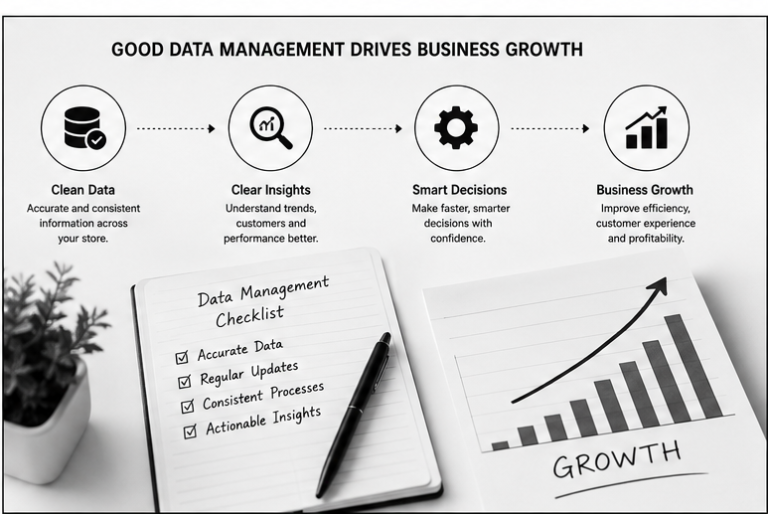
The fastest-growing Shopify stores are not successful because they have more luck or bigger budgets. They are successful because they think differently about data.
They don’t see data as reports—they see it as direction.
They don’t wait for insights—they look for them daily.
They don’t guess—they measure, test, and improve.
In modern e-commerce, data is not just a tool. It is the foundation of every decision.
And the stores that understand this early are the ones that grow the fastest, scale the smartest, and dominate the competition.