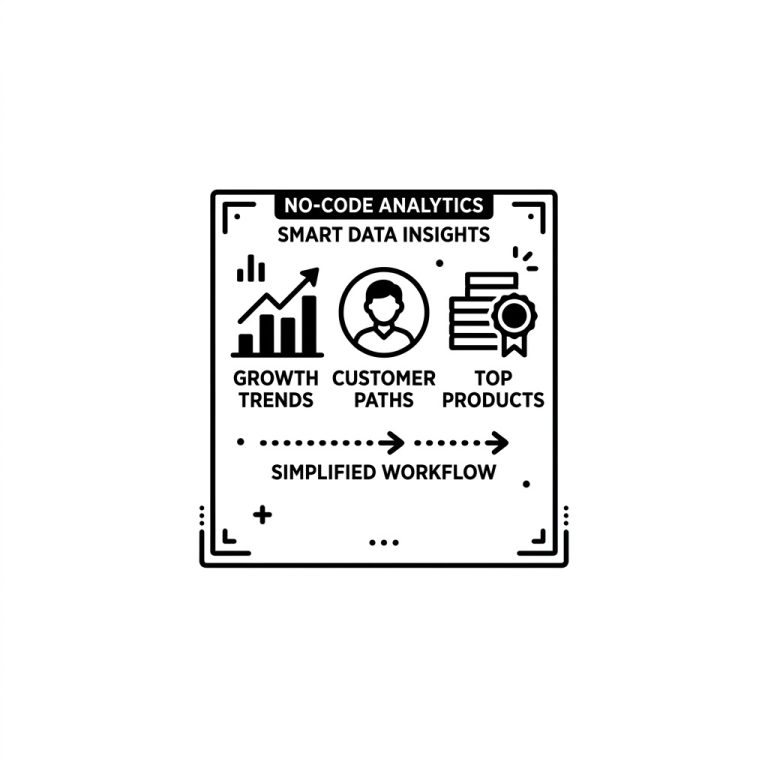

Managing Shopify Data Without Coding: How Modern Store Owners Control Their Business Without Technical Skills
One of the biggest misconceptions about eCommerce is that running an online store requires coding knowledge. Many beginners believe they must learn programming, hire developers, or understand complex technical systems before they can successfully manage products, customers, inventory, orders, and store operations.
In reality, modern eCommerce platforms have evolved significantly. Today, many store owners manage large online businesses without writing a single line of code.
From product management and inventory updates to customer segmentation and reporting, most store operations can now be controlled through visual dashboards, drag-and-drop systems, and automation-focused interfaces designed for non-technical users.
This shift has changed the entire eCommerce industry.
Entrepreneurs no longer need to be developers first.
They can focus on:
- Branding
- Marketing
- Customer experience
- Product selection
- Business growth
while using simplified systems to manage technical operations behind the scenes.
The idea of “Shopify data without coding” reflects this growing movement toward no-code commerce management. It represents the desire for store owners to:
- Control data easily
- Customize operations visually
- Avoid developer dependency
- Move faster operationally
- Manage stores independently
Let’s explore why no-code store management has become so important, how businesses handle data without programming knowledge, and why operational simplicity is now a major competitive advantage in eCommerce.
The Rise of No-Code eCommerce
In the early days of online stores, managing eCommerce systems was highly technical.
Businesses often needed developers for:
- Product uploads
- Theme changes
- Inventory management
- Checkout modifications
- Data exports
- Integrations
- Customer workflows
Even small changes could require technical expertise.
This created major problems:
- High development costs
- Slow operational changes
- Constant developer dependency
- Difficult scaling for small businesses
As eCommerce expanded globally, platforms began simplifying store management so non-technical entrepreneurs could run businesses independently.
This led to the rise of:
- Visual dashboards
- Drag-and-drop builders
- Automation systems
- Spreadsheet-style editors
- Point-and-click configuration tools
The goal became simple:
make online business management accessible to everyone.
What “Shopify Data Without Coding” Really Means
When people talk about managing Shopify data without coding, they usually mean:
- Editing products visually
- Updating inventory easily
- Organizing collections
- Managing customer information
- Creating reports
- Automating workflows
- Importing/exporting data
- Customizing store behavior without programming
It does not necessarily mean zero technical understanding.
Rather, it means the business owner can manage operations through interfaces designed for usability instead of code development.
This is extremely important for:
- Small businesses
- Solo entrepreneurs
- Dropshipping stores
- Print-on-demand sellers
- Growing brands
- Non-technical founders
Why Store Owners Want Less Developer Dependency
One major reason no-code management has become popular is because businesses want operational independence.
Relying constantly on developers creates challenges:
- Delayed updates
- Higher maintenance costs
- Slower testing
- Communication bottlenecks
- Reduced flexibility
For example:
A store owner may want to:
- Update product descriptions
- Launch seasonal collections
- Change homepage banners
- Create promotional sections
If every small task requires a developer, growth slows significantly.
Modern eCommerce businesses need speed.
No-code management gives businesses more agility.
Product Management Without Coding
One of the most important areas of no-code store management is product control.
Store owners now manage:
- Titles
- Descriptions
- Pricing
- Variants
- Inventory
- Images
- Collections
- Tags
through visual dashboards.
This matters because product catalogs change constantly.
Businesses frequently:
- Add new products
- Adjust pricing
- Update descriptions
- Improve SEO
- Create bundles
- Launch campaigns
Without simplified interfaces, even basic operations would become overwhelming.
Inventory Management Has Become More Accessible
Inventory systems used to require complex databases and technical administration.
Today, many businesses handle inventory visually through:
- Tables
- Bulk editors
- Import/export systems
- Inventory dashboards
This allows non-technical users to:
- Track stock
- Monitor low inventory
- Adjust quantities
- Manage multiple locations
- Handle supplier updates
without programming knowledge.
Inventory accessibility is especially important for scaling businesses with large catalogs.
Customer Data Without Technical Complexity
Customer data is one of the most valuable assets in eCommerce.
Modern systems now allow businesses to manage:
- Customer profiles
- Purchase history
- Segmentation
- Marketing groups
- Loyalty behavior
- Order tracking
through simplified interfaces.
Store owners can create customer experiences without needing database expertise.
For example:
Businesses can group customers based on:
- Purchase frequency
- Spending behavior
- Location
- Product interest
without writing queries manually.
This makes advanced marketing more accessible.
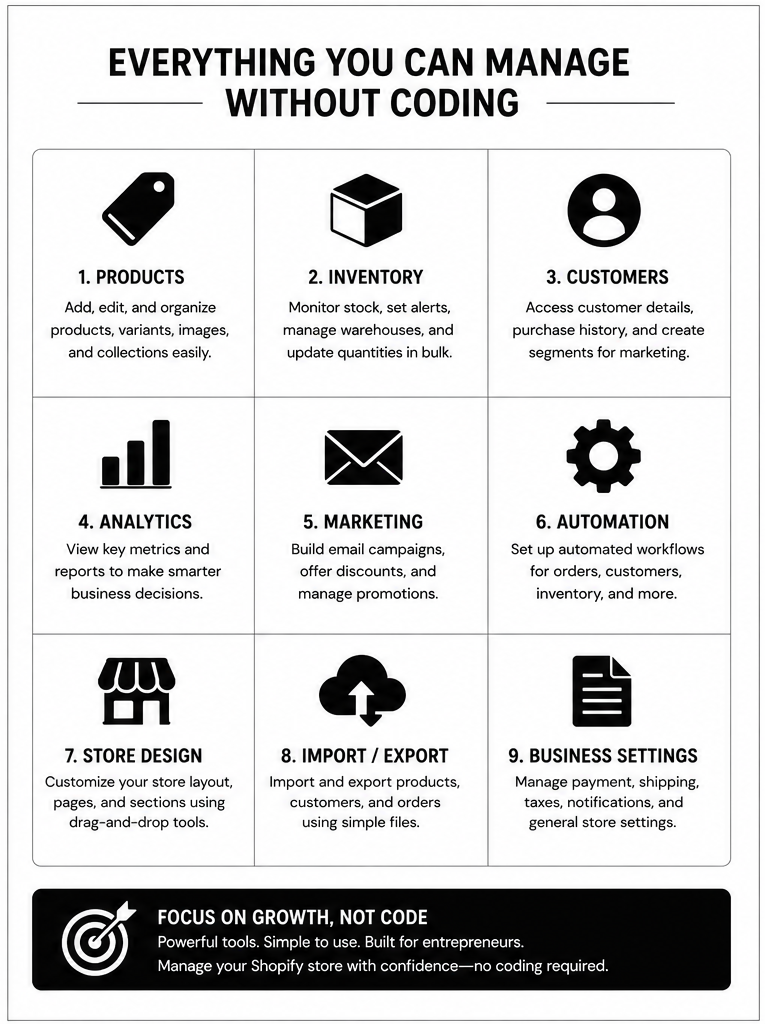
Reporting and Analytics Without Programming
Another major shift in eCommerce is the democratization of business analytics.
Previously, data reporting often required:
- SQL knowledge
- Spreadsheet expertise
- Data engineering
- Technical dashboards
Now, businesses access:
- Sales reports
- Traffic insights
- Conversion data
- Inventory analytics
- Customer trends
through visual reporting systems.
This allows entrepreneurs to make data-driven decisions without technical backgrounds.
Better accessibility leads to faster decision-making.
Why No-Code Automation Is Growing Rapidly
Modern eCommerce businesses increasingly rely on automation.
But automation no longer requires software development expertise.
Businesses can now automate:
- Order workflows
- Inventory syncing
- Customer tagging
- Email triggers
- Fulfillment actions
- Product organization
through rule-based visual systems.
This saves enormous amounts of manual work.
For growing stores, automation becomes critical because operational complexity increases rapidly with scale.
The Balance Between Simplicity and Flexibility
While no-code systems improve accessibility, they also introduce limitations.
Visual systems are designed for simplicity.
But highly custom business logic sometimes still requires deeper technical work.
This creates a balance between:
- Ease of use
- Custom flexibility
Many businesses start with fully no-code operations but later require:
- Custom workflows
- Advanced integrations
- Specialized functionality
as they scale.
Still, the ability to operate efficiently without coding provides major advantages during growth stages.
Why Beginners Benefit Most From No-Code Systems
No-code eCommerce management is especially valuable for beginners.
New entrepreneurs already face many challenges:
- Product selection
- Marketing
- Branding
- Customer acquisition
- Supplier management
If they also needed deep technical skills, launching a store would become far more difficult.
Simplified systems reduce entry barriers significantly.
This is one reason eCommerce entrepreneurship has grown globally:
technology has become more accessible.
Store Design Without Coding
Modern storefront customization has also evolved dramatically.
Store owners can now:
- Rearrange sections visually
- Customize layouts
- Add banners
- Create landing pages
- Organize homepage blocks
without editing code directly.
This gives businesses more creative control while reducing technical dependency.
Design agility matters because:
- Campaigns change frequently
- Seasonal promotions evolve constantly
- Customer preferences shift rapidly
Visual editing systems allow faster experimentation.
Bulk Data Management Saves Time
As stores grow, manual editing becomes inefficient.
Modern systems now support bulk operations for:
- Product updates
- Pricing adjustments
- Inventory changes
- Collection management
- Tag organization
This allows businesses to manage large catalogs quickly without complex database management.
Efficiency becomes essential for scaling operations.
Why Data Accessibility Improves Decision-Making
One major benefit of simplified data systems is faster business insight.
When store owners can easily access:
- Sales performance
- Inventory trends
- Customer behavior
- Product performance
they make better strategic decisions.
Businesses no longer need technical teams just to understand store performance.
This creates operational empowerment.
The Hidden Value of Simplicity
Many businesses underestimate how valuable operational simplicity is.
Complex systems often create:
- Confusion
- Training difficulties
- Errors
- Slower workflows
Simple systems improve:
- Team productivity
- Decision speed
- Operational confidence
- Scalability
The easier data management becomes, the faster businesses can focus on growth activities.
No-Code Commerce Does Not Mean No Strategy
An important distinction must be made:
removing coding complexity does not remove business complexity.
Even with simplified systems, businesses still need:
- Strong branding
- Product strategy
- Marketing execution
- Customer experience optimization
- Inventory planning
No-code tools improve accessibility —
but business success still depends on strategic execution.
The Future of eCommerce Operations
The future of eCommerce is moving toward:
- More automation
- More visual systems
- More AI-assisted workflows
- Less technical friction
- Faster operational control
Businesses increasingly expect:
- Instant editing
- Real-time data
- Flexible automation
- Simplified customization
The industry is evolving toward operational accessibility rather than technical exclusivity.
Why Operational Speed Matters
Modern eCommerce is highly competitive.
Businesses must react quickly to:
- Market trends
- Inventory changes
- Customer demand
- Seasonal campaigns
- Advertising performance
No-code systems improve operational speed because store owners can implement changes immediately without waiting for technical support.
Speed creates competitive advantage.
The Bigger Shift in Digital Business
The move toward no-code data management reflects a larger transformation happening across digital business overall.
Technology is becoming:
- More user-friendly
- More visual
- More accessible
- More business-focused
The goal is no longer forcing entrepreneurs to become programmers.
The goal is enabling entrepreneurs to focus on business growth while technology handles complexity behind the scenes.
Final Thought
Managing Shopify data without coding is no longer just a convenience —
it has become an important operational advantage for modern online businesses.
Store owners increasingly want the freedom to:
- Control products
- Manage inventory
- Analyze data
- Customize storefronts
- Automate workflows
without relying constantly on technical development.
This shift toward no-code commerce has made eCommerce more accessible, scalable, and entrepreneur-friendly than ever before.
Conclusion
The ability to manage Shopify data without coding represents one of the biggest evolutions in modern eCommerce.
Visual dashboards, automation systems, simplified inventory management, and user-friendly interfaces now allow businesses to operate efficiently without deep technical expertise.
This empowers entrepreneurs to focus on:
- Customer experience
- Marketing
- Branding
- Growth strategy
instead of technical complexity.
While advanced customization may still require specialized development in some cases, most day-to-day store operations can now be managed through accessible no-code systems designed for speed and simplicity.
In today’s eCommerce environment, operational flexibility and ease of control are becoming just as important as technology itself.
Because the businesses that move fastest are often the ones that can manage their stores independently and adapt quickly without technical barriers.