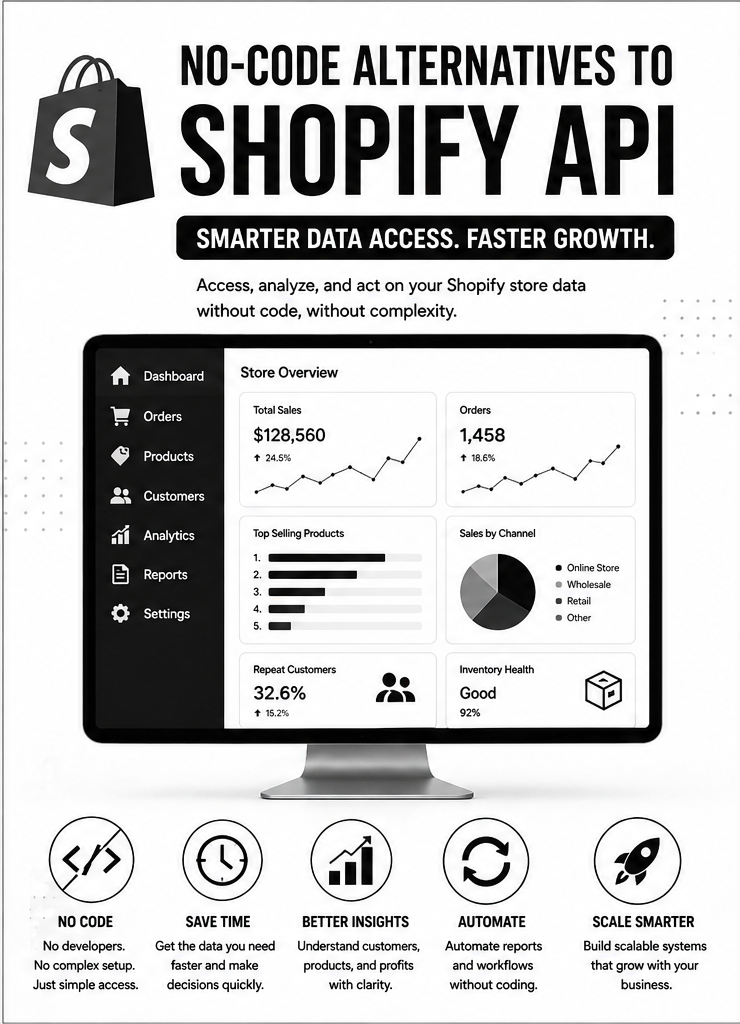
No-Code Alternatives to Shopify API: Smarter Data Access for Modern E-commerce
Introduction
In today’s fast-moving eCommerce environment, data is one of the most valuable business assets. Every Shopify store generates important information every day—orders, customer activity, inventory updates, product performance, refunds, shipping details, and sales trends. This data helps businesses make smarter decisions, improve operations, and increase profitability.
Traditionally, accessing this level of store data required direct use of the Shopify API.
While APIs are powerful, they are not always practical for every business. Many store owners, marketers, operations teams, and growing brands do not have technical developers available for daily reporting needs. API access often requires coding knowledge, development support, ongoing maintenance, and technical problem-solving.
For many businesses, this creates a serious gap.
They need data, but they do not need technical complexity.
This is where no-code alternatives become valuable.
No-code solutions allow businesses to access, organize, and use Shopify store data without writing code, managing API requests, or depending heavily on developers. They simplify the process and make business intelligence more accessible to everyone involved in store operations.
This is not just about convenience.
It is about speed, efficiency, and better decision-making.
Modern eCommerce success depends on how quickly businesses can understand and act on their data.
No-code access makes that possible.
Why Traditional API Access Feels Difficult
The Shopify API is designed to provide deep access to store information.
It can retrieve customer details, order history, inventory updates, product data, shipping records, and much more.
However, using APIs directly often involves:
Authentication setup
Developer access
Technical documentation
Custom integration work
Error handling
Data formatting
Ongoing maintenance
For technical teams, this may be manageable.
For non-technical business owners, it often becomes a major obstacle.
Instead of focusing on growth, teams spend time trying to understand technical structures.
This creates delays.
A simple need like exporting customer purchase history can become a complicated process.
Businesses do not always need more technology.
Sometimes they simply need easier access.
That is why no-code alternatives are becoming the smarter choice for many Shopify brands.
No-Code Does Not Mean Limited
Many people assume that no-code solutions are less powerful than direct API access.
This is not true.
The goal of no-code systems is not to reduce capability.
It is to remove unnecessary technical barriers.
Businesses still need:
Order visibility
Inventory tracking
Sales reporting
Customer insights
Product performance analysis
Operational clarity
The difference is how that access happens.
Instead of writing scripts or managing API calls, users work with organized dashboards, automated workflows, and simplified reporting systems.
The business gets the same strategic value—
without the technical burden.
This creates stronger accessibility across the entire team.
Because data should support decision-making, not create frustration.
Faster Decisions Through Simpler Access
One of the biggest advantages of no-code solutions is speed.
In eCommerce, slow decisions create expensive problems.
Inventory may run low.
A product may suddenly trend.
Customer behavior may shift.
Refund patterns may increase.
Marketing performance may weaken.
If teams must wait for technical support every time they need information, opportunities are lost.
No-code access removes that delay.
Store owners can review information faster.
Marketing teams can adjust campaigns quickly.
Operations teams can track performance without waiting for reports.
Speed creates competitive advantage.
Businesses that act faster protect revenue more effectively than businesses that react late.
In modern commerce, speed is not optional.
It is survival.
Helping Non-Technical Teams Work Independently
Not every business has an in-house developer.
Even larger companies often struggle when every small reporting task depends on technical teams.
This creates bottlenecks.
Marketing teams wait for customer reports.
Sales teams wait for performance analysis.
Operations teams wait for inventory visibility.
Decision-making slows down.
No-code alternatives reduce this dependency.
They allow:
Business owners to track performance directly
Marketing teams to understand customer behavior
Operations managers to monitor store activity
Sales leaders to review revenue patterns
This creates independence.
And independence improves productivity.
Teams stop waiting.
They start leading.
This is especially valuable for small businesses where speed and flexibility are critical.
Better Reporting Without Spreadsheet Chaos
Many Shopify businesses still rely heavily on spreadsheets.
Reports are downloaded manually.
Files are updated repeatedly.
Teams compare multiple sheets to understand basic performance.
This creates confusion, errors, and wasted time.
Spreadsheet dependency often leads to:
Missing information
Outdated reports
Copy-paste mistakes
Reporting inconsistencies
Daily operational frustration
No-code reporting systems improve this process by creating structured visibility.
Instead of disconnected spreadsheets, businesses work with:
Clear dashboards
Automated reporting flows
Organized business insights
Real-time performance visibility
This reduces manual effort and improves confidence in decision-making.
Businesses stop managing files.
They start managing growth.
That shift is powerful.
Customer Understanding Becomes Easier
Customer behavior is one of the strongest drivers of eCommerce success.
But understanding customers often becomes difficult when data is scattered.
Businesses need to know:
Who buys repeatedly
Which products create loyalty
Where customers abandon purchases
What drives repeat sales
Why customers stop returning
Without simple access, these insights remain hidden.
No-code systems help teams understand customer behavior clearly and quickly.
This supports:
Better retention strategies
Personalized marketing
Improved customer experience
Higher conversion rates
Long-term brand loyalty
Repeat customers are often more valuable than new customers.
That is why customer understanding is not just useful—
it is essential.
And simpler access makes that understanding stronger.
Inventory Management Without Complexity
Inventory mistakes are expensive.
Too much stock blocks working capital.
Too little stock creates missed sales.
Slow-moving products reduce profitability quietly over time.
Many businesses notice these problems too late because inventory visibility is weak.
No-code access improves inventory management by helping teams understand:
Fast-selling products
Slow inventory movement
Restocking priorities
Seasonal demand patterns
Supplier performance
This supports:
Stronger cash flow management
Better purchasing decisions
Improved operational efficiency
Healthier profit margins
Inventory stops feeling like a constant problem.
It becomes a controlled growth strategy.
And financial control improves business stability.
Scaling Growth Without Adding Operational Stress
As Shopify stores grow, complexity increases.
More products mean more reporting.
More customers create more service needs.
More transactions create more operational pressure.
Manual systems that once worked become difficult to manage.
This is where no-code solutions become even more valuable.
They support scale by maintaining:
Clear reporting structures
Consistent operational visibility
Reliable business insights
Simplified workflows
Stronger planning control
Growth becomes organized instead of stressful.
Businesses can expand without losing confidence in daily operations.
Scaling should create opportunity—
not confusion.
No-code systems help protect that balance.
Business Confidence Starts with Clarity
One of the strongest benefits of better data access is confidence.
When store owners cannot trust their reports, every decision feels risky.
Should pricing change?
Should marketing spend increase?
Should a product line expand?
Should inventory investment grow?
Unclear information creates hesitation.
Clear visibility creates confidence.
No-code systems help leaders make decisions based on facts instead of assumptions.
This improves:
Strategic planning
Team leadership
Financial control
Growth forecasting
Long-term stability
Confidence is often the hidden reason behind successful businesses.
Because businesses that move confidently grow faster than businesses that hesitate.
And clarity creates that confidence.
The Future of Shopify Operations
The future of eCommerce belongs to businesses that work intelligently.
This means reducing unnecessary complexity and improving access to information.
Modern Shopify success requires:
Real-time visibility
Connected business reporting
Smarter customer understanding
Better inventory control
Faster operational decisions
Scalable workflows
Businesses that continue depending only on technical bottlenecks will struggle to compete.
Success is no longer about working harder.
It is about removing friction.
No-code alternatives create invisible efficiency with visible results.
They help businesses focus less on technical processes and more on strategic growth.
That is where true competitive advantage begins.
Final Thoughts
No-code alternatives to Shopify API are not just a convenience.
They are a smarter way to run modern eCommerce businesses.
They transform:
Technical barriers into business accessibility
Manual reporting into operational clarity
Delayed decisions into faster action
Data complexity into strategic leadership
Most importantly, they allow businesses to use information with confidence—without depending on coding knowledge for every decision.
The goal of data is not complexity.
It is clarity.
And clarity creates growth.
Businesses that simplify access to their store data do not just save time.
They build stronger operations, smarter leadership, and more sustainable success.
In the end, the best system is not the most technical one.
It is the one that helps the business grow faster, smarter, and with greater confidence.