How to Use Shopify Store Data Without API: A Practical Guide for Non-Technical Users
In today’s eCommerce world, data plays a crucial role in shaping business success. Every action inside a Shopify store—whether it’s a product view, a cart addition, or a completed purchase—generates valuable information. This data helps businesses understand customer behavior, improve products, and make better decisions. However, many people believe that accessing this data requires technical knowledge, coding skills, or API usage.
The truth is, Shopify data can be used effectively without relying on APIs. With the right approach, even non-technical users can access, organize, and use data in a simple and efficient way. The key lies in shifting from technical dependency to smart, simplified workflows.
Understanding the Real Challenge
The main challenge is not collecting data—it’s making it usable.
Shopify stores already generate large amounts of data. The difficulty arises when this data is:
- Hard to access
- Scattered across different sections
- Time-consuming to organize
Traditional methods often involve technical processes that create a gap between data and decision-making. This gap slows down business growth and limits the ability to act quickly.
A better approach focuses on making data accessible, structured, and ready to use—without requiring technical skills.
Why Avoid APIs?
Avoiding APIs does not mean limiting your capabilities—it means simplifying your workflow.
Here are the main advantages of using Shopify data without APIs:
1. Simplicity
No coding or technical setup is required. Anyone can work with data using basic tools and interfaces.
2. Speed
Data can be accessed and used quickly without waiting for development or integration.
3. Accessibility
Different teams—marketing, operations, and sales—can work with data independently.
4. Cost Efficiency
There is no need to invest in developers or complex systems.
This approach allows businesses to focus on insights rather than technical processes.
Using Shopify’s Built-in Features
One of the easiest ways to access data without APIs is through Shopify’s built-in features.
Data Export Options
Shopify allows users to export:
- Orders
- Customers
- Products
- Inventory
These exports are usually available in CSV format, which can be opened and edited easily.
Benefits
- Simple and direct
- No technical knowledge required
- Easily accessible from the dashboard
Limitations
- Manual process
- Needs to be repeated frequently
- Data may not be real-time
While useful, this method is better suited for basic data needs rather than continuous analysis.
Moving Toward Automated Workflows
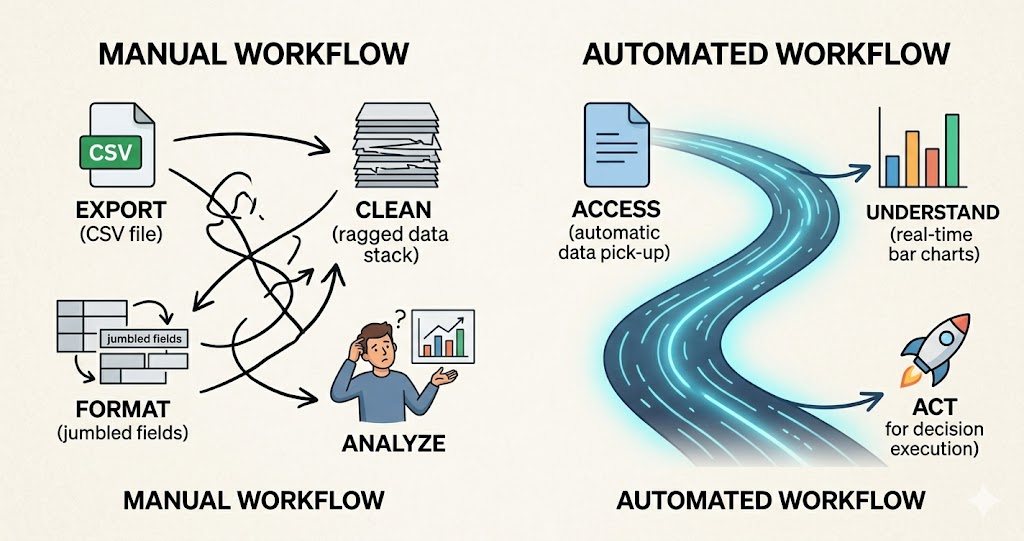
Manual processes can quickly become repetitive. Exporting data, cleaning it, and organizing it again and again takes time and effort.
A smarter approach replaces these repetitive steps with automation.
Instead of:
Export → Clean → Format → Analyze
You move toward:
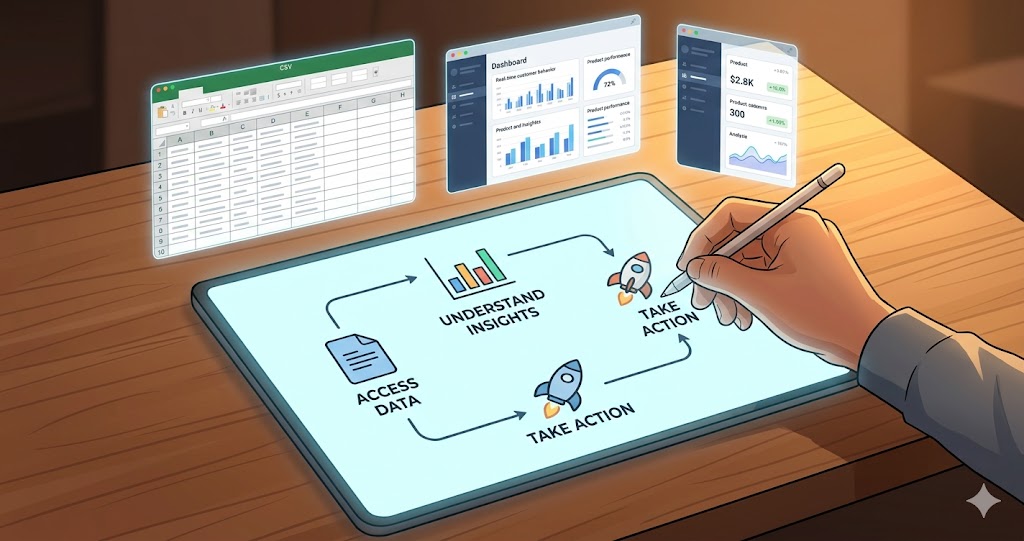
Access → Understand → Act
Automation ensures that data is:
- Continuously updated
- Properly structured
- Ready to use
This eliminates delays and reduces manual effort.
From Static Data to Continuous Flow
Traditional methods treat data as something static—something you collect once and analyze later.
A modern approach treats data as a continuous flow.
This means:
- Data updates regularly
- Insights reflect current performance
- Decisions are based on real-time activity
This shift allows businesses to stay responsive and adapt quickly to changes.
Organizing Data for Better Clarity
Raw data is often messy and difficult to understand. It may include unnecessary fields, inconsistent formats, or scattered information.
A structured approach organizes data into:
- Clear categories
- Consistent formats
- Meaningful groupings
This makes it easier to:
- Identify trends
- Compare performance
- Draw insights
Instead of working with confusion, businesses operate with clarity.
Turning Data into Insights
Data becomes valuable only when it is understood and used effectively.
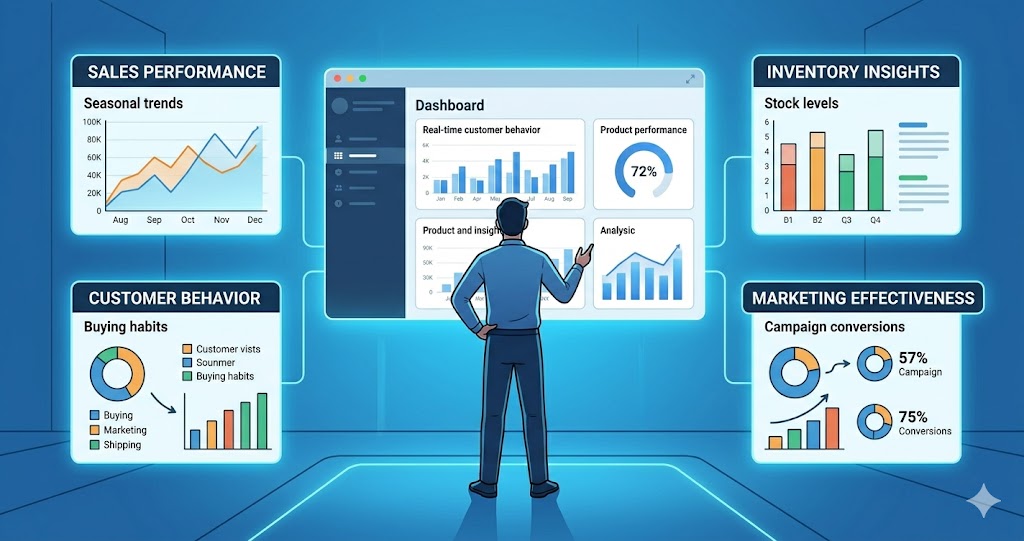
When properly organized, Shopify data can provide insights such as:
Sales Performance
- Which products are selling the most
- Revenue trends over time
- Seasonal patterns
Customer Behavior
- Buying habits
- Repeat purchase rates
- Customer preferences
Inventory Insights
- Stock levels
- Fast-moving products
- Slow-moving items
Marketing Effectiveness
- Campaign performance
- Conversion trends
- Customer engagement
These insights help businesses make informed decisions and improve overall performance.
Reducing Errors and Increasing Accuracy
Manual data handling often leads to mistakes:
- Incorrect entries
- Missing information
- Formatting issues
A simplified and automated approach reduces these errors by:
- Maintaining consistency
- Eliminating manual input
- Standardizing data formats
Accurate data leads to better insights, and better insights lead to better decisions.
Empowering Non-Technical Users
One of the biggest advantages of avoiding APIs is accessibility.
When data is easy to use:
- Business owners can analyze performance themselves
- Marketing teams can track results instantly
- Operations teams can manage inventory efficiently
This removes dependency on technical experts and speeds up workflows.
Scaling Without Complexity
As a Shopify store grows, its data becomes more complex.
Manual systems that work for small stores often fail at larger scales.
A simplified system ensures:
- Data remains organized
- Insights remain accessible
- Processes remain efficient
This allows businesses to scale without being overwhelmed.
Integrating Data into Daily Decisions
Data should not be something you check occasionally—it should guide everyday actions.
With easy access to data:
- Teams can monitor performance regularly
- Decisions can be made quickly
- Strategies can be adjusted in real time
This integration creates a more agile and responsive business.
Eliminating Repetitive Work
Repetition is one of the biggest inefficiencies in data handling.
Tasks like exporting, cleaning, and updating data consume valuable time.
A smarter approach eliminates these repetitive tasks by:
- Streamlining workflows
- Keeping data ready for use
- Reducing manual effort
This allows teams to focus on growth rather than operations.
Aligning Data with Business Goals
Not all data is useful. The key is to focus on what matters.
Relevant data includes:
- Revenue growth
- Customer retention
- Product performance
By focusing on meaningful metrics, businesses can avoid information overload and make better decisions.
Bridging the Gap Between Data and Action
Having data is not enough—the real value lies in using it.
A simplified system connects:
Understanding → Decision → Action
This makes it easier to:
- Identify opportunities
- Implement changes
- Measure results
This connection transforms data into a powerful business tool.
The Future of Data Without APIs
The shift toward no-code and simplified workflows is growing rapidly.
Businesses are moving toward:
- Easier tools
- Faster processes
- Greater independence
In the future, accessing and using data will become even more intuitive, reducing reliance on technical methods.
Final Perspective
Using Shopify store data without APIs is not only possible—it is highly practical.
By focusing on simplicity, automation, and structured workflows, businesses can:
- Access data easily
- Save time
- Reduce complexity
- Improve decision-making
This approach transforms data from a technical challenge into a strategic advantage.
In Essence
You don’t need APIs to work with Shopify data.
You need a smarter approach.
When data becomes simple, accessible, and continuous, it turns into a powerful driver of growth, efficiency, and success. 🚀