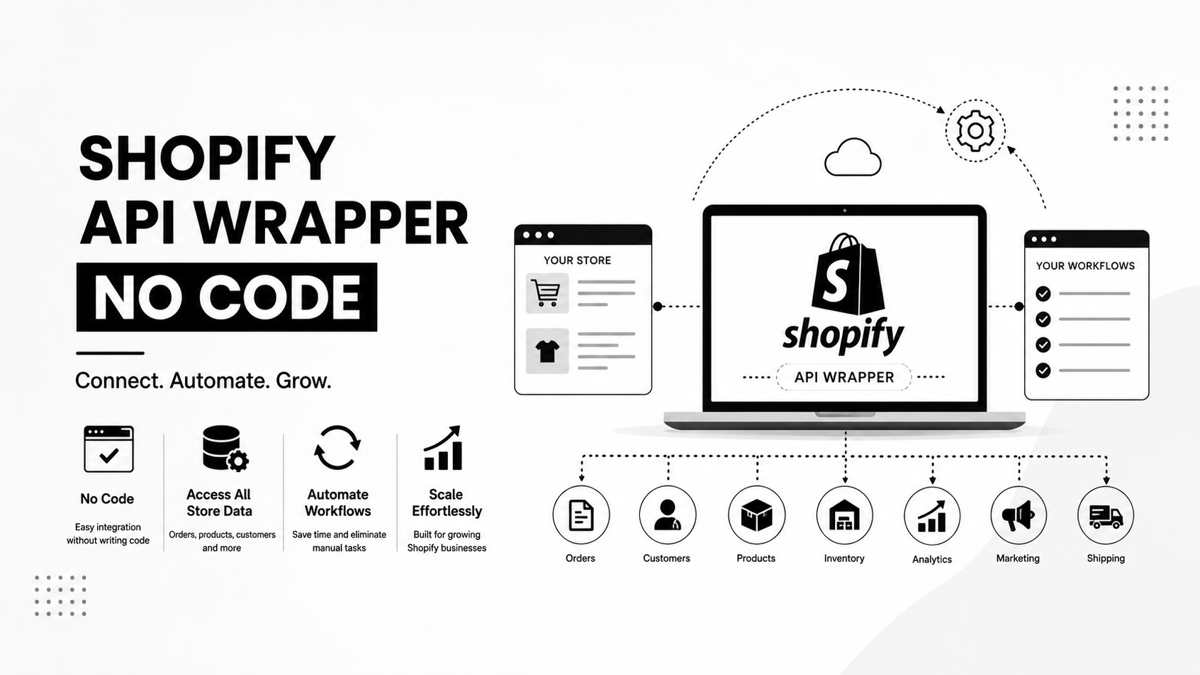
Modern eCommerce businesses operate in an environment where speed, automation, and data accessibility have become essential for growth. Shopify stores today generate enormous amounts of operational information every minute. Orders, customer activity, product updates, inventory changes, shipping details, marketing performance, and sales analytics all create valuable business data.
But while Shopify provides access to this information, many businesses face a major challenge:
Most store owners are not developers.
They want the benefits of advanced store functionality and connected systems without dealing with coding complexity, technical infrastructure, or difficult integrations. This growing demand has pushed businesses toward simpler and more accessible operational systems.
One of the most important developments in modern eCommerce operations is the rise of the no-code Shopify API wrapper approach.
This operational model helps businesses interact with Shopify store data and workflows in a much simpler, more accessible way without requiring advanced programming knowledge.
Instead of writing complex backend logic or managing technical integrations manually, businesses can work with organized systems that simplify how Shopify information flows across operations.
This shift is transforming how modern eCommerce companies manage growth, scalability, and operational efficiency.
Understanding Shopify Store Connectivity
Every Shopify store contains multiple layers of operational information.
These include:
- Product data
- Inventory details
- Customer records
- Order information
- Sales analytics
- Shipping activity
- Checkout behavior
- Marketing performance
- Collection organization
- Store configuration settings
As stores grow, businesses often need this information to move between different workflows and operational systems.
For example:
- Marketing teams need customer insights
- Operations teams need inventory visibility
- Finance teams require sales reporting
- Leadership needs performance summaries
- Customer support requires order access
Without organized connectivity, businesses quickly face operational inefficiencies.
Information becomes fragmented. Workflows slow down. Manual management increases.
Modern Shopify businesses need systems that simplify operational data movement and improve accessibility across the business.
Why Businesses Want No-Code Operations
Traditional technical systems often create barriers for non-technical teams.
Many businesses struggle with:
- Complex setup requirements
- Developer dependency
- Technical maintenance
- Slow implementation timelines
- Difficult integrations
- Complicated workflows
This creates operational friction.
Store owners and business teams increasingly want systems that allow them to focus on business growth instead of technical management.
The no-code operational movement emerged because businesses recognized an important reality:
Operational simplicity improves productivity.
Businesses want to access store functionality without constantly relying on technical expertise.
This is especially important for:
- Small Shopify businesses
- Growing eCommerce brands
- Lean operational teams
- Fast-moving online stores
- Multi-channel retailers
The goal is simple:
Reduce technical barriers while improving operational efficiency.
Simplifying Store Data Access
One of the biggest operational challenges in eCommerce is organizing large amounts of Shopify store data.
As stores scale, businesses manage increasing volumes of:
- Orders
- Product variations
- Customer interactions
- Sales reports
- Inventory movement
- Marketing campaigns
Without organized operational systems, this information becomes difficult to manage efficiently.
Businesses often rely on:
- Manual spreadsheets
- Repetitive exports
- Disconnected workflows
- Time-consuming reporting
- Administrative coordination
This creates operational overload.
A no-code Shopify API wrapper approach helps simplify how businesses interact with store information.
Instead of technical complexity, businesses gain more streamlined operational access to important store activity.
This improves visibility, efficiency, and workflow coordination.
Reducing Dependence on Technical Teams
Many Shopify businesses experience delays because operational changes depend heavily on developers or technical specialists.
For example:
- A team may need updated reports
- Inventory visibility may require integration changes
- Customer data workflows may need adjustments
- Operational processes may require configuration updates
When every operational improvement requires technical involvement, businesses lose agility.
The no-code operational approach reduces this dependency.
Business teams gain greater control over workflows and operational visibility without constantly waiting for development resources.
This improves operational flexibility and allows businesses to move faster.
Faster Workflows Improve Business Performance
Modern eCommerce moves extremely quickly.
Customer expectations continue increasing. Competition is growing. Operational speed matters more than ever.
Businesses now need faster access to:
- Store insights
- Customer activity
- Sales performance
- Operational reporting
- Inventory updates
- Order visibility
Slow workflows create delayed decisions.
And delayed decisions often create missed opportunities.
For example:
- Marketing campaigns may continue underperforming
- Fast-selling products may run out of stock
- Customer retention issues may remain hidden
- Operational inefficiencies may grow unnoticed
Simplified Shopify operational systems help businesses reduce these delays and improve workflow responsiveness.
The faster businesses access and organize information, the faster they can take action.
The Shift Away From Spreadsheet Dependency
Many Shopify businesses still rely heavily on spreadsheets for operational management.
While spreadsheets can be useful initially, they become increasingly difficult to manage as stores scale.
Common spreadsheet problems include:
- Manual updates
- Duplicate information
- Reporting inconsistencies
- Collaboration confusion
- Version conflicts
- Delayed visibility
- Human error risks
As operations grow, spreadsheet dependency creates operational bottlenecks.
Modern businesses increasingly want connected operational systems instead of isolated manual reporting processes.
A no-code Shopify API wrapper approach supports this transition by helping businesses simplify how store data flows across workflows.
This creates a more scalable operational structure.
Improving Operational Visibility
Visibility is one of the most important factors in eCommerce success.
Businesses perform better when teams clearly understand:
- Current performance
- Customer behavior
- Inventory movement
- Revenue trends
- Operational bottlenecks
- Workflow efficiency
Poor visibility creates uncertainty.
Businesses begin making decisions based on assumptions instead of accurate operational understanding.
Simplified Shopify operational systems improve visibility by helping businesses organize store information more effectively.
This allows teams to identify issues earlier and respond more confidently.
Supporting Smarter Decision-Making
Modern eCommerce success depends heavily on decision quality.
Businesses constantly make decisions involving:
- Inventory planning
- Product strategy
- Customer engagement
- Marketing performance
- Sales optimization
- Operational improvements
Without clear operational visibility, these decisions become difficult.
Businesses may rely on outdated information or incomplete reporting.
Simplified Shopify workflows help improve decision-making by reducing operational complexity and improving access to organized insights.
This allows businesses to act with greater confidence and accuracy.
Helping Teams Work More Efficiently
Operational efficiency is becoming one of the biggest competitive advantages in eCommerce.
Businesses that reduce unnecessary manual work gain advantages in:
- Productivity
- Speed
- Collaboration
- Scalability
- Customer experience
A no-code operational structure helps teams spend less time managing technical complexity and more time focusing on strategic work.
For example:
- Marketing teams can focus on growth campaigns
- Operations teams can improve fulfillment efficiency
- Leadership can focus on strategy
- Customer support teams can respond faster
Simplified workflows improve the overall productivity of the business.
Scalability Requires Smarter Systems
As Shopify businesses grow, operational complexity increases rapidly.
Scaling creates:
- More products
- More customers
- More reporting needs
- More operational coordination
- More workflow dependencies
Without scalable systems, businesses often experience:
- Slower operations
- Reporting delays
- Team overload
- Data confusion
- Operational fragmentation
Modern eCommerce businesses cannot scale efficiently through manual processes alone.
They need operational systems designed for growth.
The no-code operational model supports scalability by simplifying how information flows across the business.
This reduces friction and helps businesses grow more efficiently.
Customer Experience Depends on Operational Efficiency
Customer experience is deeply connected to internal operations.
Operational inefficiencies eventually affect customers through:
- Delayed fulfillment
- Inventory errors
- Poor communication
- Slow support responses
- Inconsistent experiences
Businesses with smoother workflows often deliver stronger customer experiences because teams operate with greater visibility and coordination.
Simplified Shopify operational systems help businesses improve responsiveness and operational consistency.
This supports better customer satisfaction and stronger retention.
Real-Time Business Operations Are Becoming Essential
Modern eCommerce increasingly operates in real time.
Businesses need visibility into live operational activity because conditions change quickly.
Real-time operational awareness helps businesses:
- Respond to customer demand faster
- Manage inventory proactively
- Identify sales trends earlier
- Optimize marketing performance
- Detect operational issues quickly
Delayed operational awareness reduces agility.
Businesses that react slowly often lose opportunities.
Simplified Shopify workflow systems support faster operational access and improved responsiveness.
This creates stronger operational agility.
The Future of Shopify Operations
The future of Shopify operations is moving toward:
- Simpler workflows
- Faster operational visibility
- Connected business systems
- Reduced technical dependency
- Smarter operational coordination
- More accessible business intelligence
Businesses increasingly value systems that reduce complexity instead of increasing it.
The future is not about overwhelming businesses with more operational tools.
It is about simplifying how businesses access, organize, and understand Shopify information.
The no-code operational movement reflects this broader transformation happening across eCommerce.
Why Operational Simplicity Creates Competitive Advantage
In modern eCommerce, simplicity is becoming a strategic advantage.
Businesses with simplified workflows often:
- Move faster
- Scale more efficiently
- Collaborate better
- Respond to customers quicker
- Make decisions earlier
- Reduce operational stress
Complex systems slow businesses down.
Simplified operational structures improve momentum.
A no-code Shopify API wrapper approach supports this simplicity by helping businesses interact with store operations more efficiently without excessive technical management.
Final Thoughts
Modern Shopify businesses are entering a new era of operational management.
Success is no longer determined only by products, advertising, or traffic volume.
Operational efficiency now plays a major role in business growth.
The rise of no-code Shopify operational systems reflects a growing demand for:
- Simplicity
- Speed
- Visibility
- Scalability
- Accessibility
- Workflow efficiency
Businesses want operational systems that help them focus on growth rather than technical complexity.
By simplifying how Shopify information is accessed and organized, businesses can improve:
- Productivity
- Decision-making
- Team collaboration
- Customer experience
- Operational agility
- Long-term scalability
The future of eCommerce belongs to businesses that can manage operations intelligently without creating unnecessary complexity.
Because in modern Shopify commerce, the fastest-growing businesses are often the ones with the simplest and most efficient workflows.